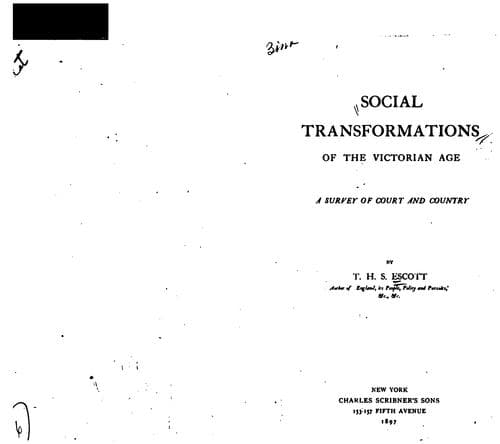
Social Transformations of the Victorian Age: A Survey of Court and CountryEscott, T. H. S. (Thomas Hay Sweet)
History
Social Transformations of the Victorian Age: A Survey of Court and Country
Escott, T. H. S. (Thomas Hay Sweet)
Great Britain -- Civilization -- 19th century; Great Britain -- Social life and customs -- 19th century
Thus sixty years ago the Militia force of the country was declared by the
Adjutant-General of the day practically to be non-existent. Before 1815
this force had been a considerable body. After the Peace it dwindled down
to less than 70,000; when the Queen mounted her throne, it was seldom or
never regularly drilled. There had been no ballot for it since 1831.
Twenty-eight years later, December 1895, the strength of an annually
trained Militia was 107,742. The Militia, too, in 1837 was administered
not as it now is by the War Office, but by the Home Secretary in
conjunction with the Lords Lieutenant of Counties; its payment was
provided for in the civil not the military estimates; in 1837 its expense
was £192,115. The Yeomanry, then called Volunteers, comprised 18,000 men
of all ranks, at a cost in round numbers of £105,400. In 1897 the
Yeomanry, instructed not less systematically than the Militia, were a
force of 11,678 men.
Important additions to the permanent strength of the country against an
emergency were made, largely on the Prince Consort's initiative, during
the first decade of the reign. In 1842 the military pensioners already
enrolled and liable to service were regularly organized, less however as a
military power than as an aid to the civil Government, to the number of
7,000 men. This, too, was the period in which (1846) Sir John Burgoyne
submitted to Lord John Russell a State paper on that subject of coast
defences which had already engaged the Duke of Wellington and had been
taken up warmly as mentioned above by the Queen's husband. The Channel
Tunnel scheme was then unborn in the brains of future projectors. Our
military experts held England sufficiently to be weakened as it was by
the isthmus of steam which bridged the Straits of Dover. Sir John
Burgoyne's estimate in 1846 was that after providing for Ireland and for
home fortifications, only a maximum of 10,000 men could be placed in the
field; that the entire United Kingdom did not possess field guns enough
for 20,000 men; that there were no reserves of muskets or military stores;
that the dockyards were defenceless against any sudden attack. In 1847 the
apprehensions caused by these expert disclosures moved Lord Palmerston,
when Foreign Secretary in the Russell Cabinet, to suggest a loan for
military works along the Hampshire and Dorsetshire coast. Nothing,
however, was actually done until the Prince Consort in May 1859 secured
the issue of instructions to Lords Lieutenant of Counties by the War
Secretary. These resulted in the raising of the Volunteers. Lord
Palmerston was himself Prime Minister then. The attitude of Napoleon III.
towards England and the Austrian war scare of 1859 supplied the Government
with the leverage for the vote needed to strengthen the coast protection
of England in accordance with the Prince Consort's proposal of twelve
years earlier. On June 23, 1860, the earliest Volunteer Review was held in
Hyde Park.
Public-domain text, read in full here on John Shaqi.
Reviews
Reviews
No reviews yet
Be the first to share your thoughts on this work.
Elsewhere in the archive
Join the Discussion
Join the discussion
Sign in to leave a comment or review.
Sign InorCreate an account