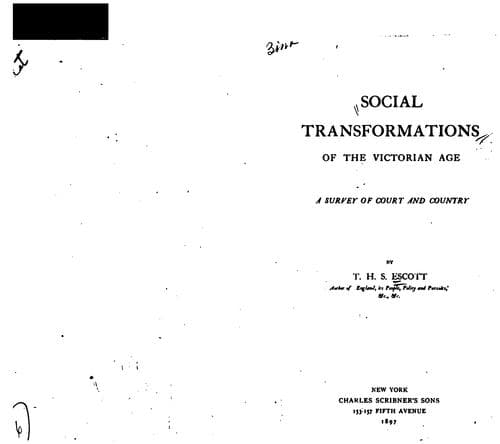
Social Transformations of the Victorian Age: A Survey of Court and CountryEscott, T. H. S. (Thomas Hay Sweet)
History
Social Transformations of the Victorian Age: A Survey of Court and Country
Escott, T. H. S. (Thomas Hay Sweet)
Great Britain -- Civilization -- 19th century; Great Britain -- Social life and customs -- 19th century
A week or so later, on July 2, the Volunteers first met on
Wimbledon Common; the competition was opened by Her Majesty discharging
her rifle and scoring the inaugural bull's eye.
A quarter of a century later the Volunteers had risen from 119,000 in 1860
to 226,752 in 1886, of whom 220,000 were efficients. At the number then
reached subject to fluctuations of some thousands periodically they seem
disposed to remain. In Great Britain 800,000 men of military age have
passed through the Volunteers. Thus, not counting our natural rampart of
sea, and a navy which public opinion, if not official patriotism, insists
on maintaining at a high point, the coast fortresses bristling in nearly
continuous array from Dover to the Land's End mask behind them little less
than 1,000,000 citizen soldiers, who with some help from their brethren of
the Royal Artillery could effectively man our coast batteries.
Military education under teachers of the new school and the class of
officers thus produced are the immediate outcome of the interest taken in
the army by the Court at, and subsequently to, the time of the Prince
Consort. The whole scheme of education under which the commanders of the
future are trained and a general anxiety for the most beneficent use of
the Queen's prerogative, were much in the thoughts of the Queen's husband.
The council of military education was largely the work of the Prince, as
also was the formation of the Aldershot camp. When a 'governor' was to be
chosen for the Prince of Wales, the selection made was the first Commander
at Aldershot and one of the chief members of the education council, Sir
William Knollys, who, on the Prince reaching his majority became chief of
his household. When that veteran was appointed Usher of the Black Rod he
was succeeded as Private Secretary to the Heir Apparent by one so
thoroughly trained to his administrative methods as his son, Sir Francis
Knollys;--a man in whom common sense attains as nearly as is conceivable
to the calibre of absolute genius. It was at the period now mentioned and
under these influences that officers in the scientific corps began to get
their proper share of army staff appointments and commands. So entirely
have the old disabilities of that corps disappeared that to-day, in
striking contrast to the earlier experience, an officer of Royal Artillery
or Royal Engineers who in general respects shows the necessary aptitude
enjoys the same chance as anyone else of staff employment in peace. When
he has reached the grade of General officer, he will not be at any
disadvantage in the process of selection for a command. Here merit alone
tells now. Whatever arm of the Service to which he belongs the best
candidate practically never fails to be chosen. Generally, in the opinion
of the best professional judges, the young officer finds the army a
self-supporting profession. The exact experience seems to be that a young
man obtaining a commission in the infantry of the Line or in the Artillery
Public-domain text, read in full here on John Shaqi.
Reviews
Reviews
No reviews yet
Be the first to share your thoughts on this work.
Elsewhere in the archive
Join the Discussion
Join the discussion
Sign in to leave a comment or review.
Sign InorCreate an account