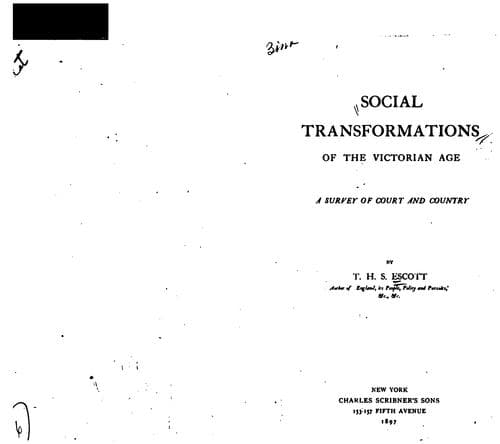
Social Transformations of the Victorian Age: A Survey of Court and CountryEscott, T. H. S. (Thomas Hay Sweet)
History
Social Transformations of the Victorian Age: A Survey of Court and Country
Escott, T. H. S. (Thomas Hay Sweet)
Great Britain -- Civilization -- 19th century; Great Britain -- Social life and customs -- 19th century
can look forward at no distant date to marrying in fair comfort, and that
as a bachelor he requires no larger allowance or private means than he
would need in any other branch of the public employ, that, for example, of
the Colonial Service.
In cavalry regiments, or in the Household Brigade, life is more costly. In
these cases, the young officer could scarcely subsist in comfort without
private resources equal to those on which young men entering the
diplomatic service must at the outset of their career be able to count.
Obviously if the army is to be made a career sufficiently attractive for
young Englishmen of first-rate abilities as well as of gentle birth, the
prizes of the profession must not, for the sake of an unwise national
economy, be too severely diminished in value. The complaint is general and
just that the emoluments of those who win their way to the top are already
unattractively small and few. It cannot be a satisfactory state of things
under which no General officer can afford, without private fortune of his
own, to take a command. Impolitic retrenchment has touched other positions
than these. Thus, quite recently the salary of the Military Secretary to
the Commander-in-Chief has been cut down from £2,100 to £1,500; that of
Adjutant-General to the Forces from £2,700 to £2,100; that of Governor of
the Royal Military Academy from £2,000 to £1,500. The unwisdom of these
reductions and the comparative smallness of the highest army stipends,
become the more apparent when it is remembered that all military
appointments, unlike civil appointments from the Primacy of Canterbury
down to a junior Treasury lordship, are for five years only, that the
installation in these posts, and the establishment they require are
necessarily costly; thus the choice is practically limited to men of
means. Nor does a timocratic[69] scheme of military preferment accord well
with the democratic ideal of careers unrestrictedly open to all talents.
Public-domain text, read in full here on John Shaqi.
Reviews
Reviews
No reviews yet
Be the first to share your thoughts on this work.
Elsewhere in the archive
Join the Discussion
Join the discussion
Sign in to leave a comment or review.
Sign InorCreate an account