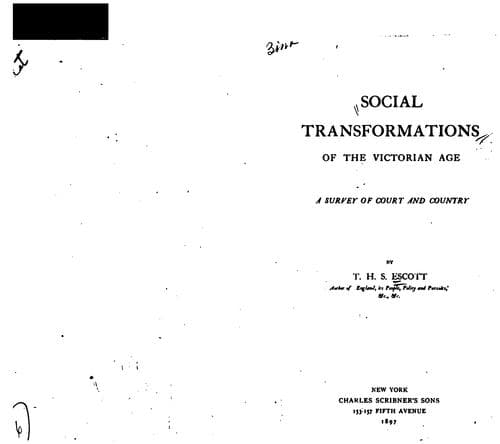
Social Transformations of the Victorian Age: A Survey of Court and CountryEscott, T. H. S. (Thomas Hay Sweet)
History
Social Transformations of the Victorian Age: A Survey of Court and Country
Escott, T. H. S. (Thomas Hay Sweet)
Great Britain -- Civilization -- 19th century; Great Britain -- Social life and customs -- 19th century
The iron-plated ship of the modern type appears to have been a French
idea, first tried by Colonel Paixhaus in 1825. The floating batteries
employed in the Crimean War in which Napoleon III. was specially
interested, marked a fresh advance in this direction. Nor does it seem
easy to overrate the value of the lessons in scientific seamanship derived
from the French and English operations on the Black Sea, 1854-5. The
result was the invitation by the Admiralty of designs from all quarters,
the ordering of the 'Warrior,' designed by Mr Scott Russell, in 1859,
completed in 1861.[74] This vessel was equipped with a battery extending
her whole length. Before the fifties were out, the naval and the national
mind had been familiarized with the idea of mastless ships, long repulsive
to the national sense of the picturesque at sea. The 'Warrior,' however,
was furnished with sails in addition to steam and marked an epoch in the
development not only of the English navy, but of the navies of the world,
as the first absolutely complete iron ship ever built.
The French ships, earlier in point of time were not equally perfect as
regards material. They were, in fact, wooden ships cut down and plated
with iron. Thus with literal truth referring to the launch of 'Warrior'
could our Naval Minister of the day, Sir John Pakington, describe the
whole world as interested in the bold experiment. Other ships of the same
kind soon followed, and of even larger proportions. It is to the credit of
English workmanship that the building of these vessels at Chatham was
performed by shipwrights who had hitherto worked only on wood; and that
the craftmanship shown by them in the new material was pronounced by
experts to be excellent. Timber having been definitely superseded by
metal, there followed the long and technical controversy about the
relative merits of turret and broadside armaments. The concentration of
guns into a single citadel on board ship was first in England powerfully
advocated by Sir E. Reed. Since then, the naval warfare between Federals
and Confederates on the other side of the Atlantic, followed by the
exciting manoeuvres off Cherbourg between the 'Alabama' and the
'Keersage,' and in Europe the naval portions of the Austro-Italian war of
1866 have taught lessons the full results of which are not, perhaps even
yet, perfectly realized. So long is the experimental stage which has to be
traversed before the newest system of maritime defence and attack with its
complicated machinery can be said entirely to have reached what is alone
to be called properly the scientific stage.[75]
CHAPTER XXIII
TRANSFORMATIONS OF VICTORIAN SCIENCE
Public-domain text, read in full here on John Shaqi.
Reviews
Reviews
No reviews yet
Be the first to share your thoughts on this work.
Elsewhere in the archive
Join the Discussion
Join the discussion
Sign in to leave a comment or review.
Sign InorCreate an account