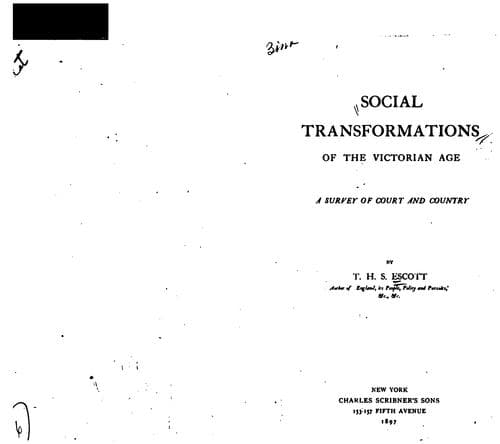
Social Transformations of the Victorian Age: A Survey of Court and CountryEscott, T. H. S. (Thomas Hay Sweet)
History
Social Transformations of the Victorian Age: A Survey of Court and Country
Escott, T. H. S. (Thomas Hay Sweet)
Great Britain -- Civilization -- 19th century; Great Britain -- Social life and customs -- 19th century
The Prince Consort's influence in organizing pursuits and departments
of knowledge, a characteristic of the Victorian age. The Prince not
only the advocate of the 1851 Exhibition, but most active in the
movement that has given us South Kensington as an instrument in the
knowledge of art and science. The British Association foreshadowed by
a like organization in Germany which may have impressed the youthful
Prince Albert, but certainly set the example to the leaders of English
science. Like its German forerunners the British Association gradually
grew in popular favour. Its progress as shown by facts and figures.
Modern course of science summarized. The transforming influences of
science traced in all intellectual pursuits.
If in a few words the contrast between the England of the later and the
earlier part of the Queen's reign were to be summed up, it might be
expressed by the single word, organization. For that process, as for its
most impressive results, Victorian England is indebted primarily to the
husband of its Queen. To-day Englishmen are reminded locally and visibly
of the Great Exhibition of 1851 by the elaborately picturesque memorial of
the man who spared no pains to secure its success, situated, as that
monument is, on the spot where the great glass house once stood.
That event was the earliest triumph of the new epoch of culture including
science in its application to the conveniences or luxuries of daily life.
From 1851 too, may be dated the organized encouragement of the inventor in
all departments of scientific ingenuity.
Such a world's show might in due course have been devised by the wit of
man, even if the Queen's husband had not recalled for reproduction in
England the idea of the Frankfort fairs of the sixteenth century.[76] It
is quite certain that without the Prince's personal enterprise and
sustained supervision, and but for the invaluable co-operation of the late
Sir Henry Cole, the movement which has transformed the Court suburb from
laundry grounds, or riding schools, into a centre of artistic or
scientific education for the whole country had it taken place at all,
would not have occurred till many years later than it actually did. The
contrast between the South Kensington of the Queen's accession year with
its suburban desolations, and of the sixtieth anniversary year, with its
palaces of art, its private mansions rivalling those of Park Lane, its
Imperial Institute, its provision for educational classes by day, for
musical fêtes by lamplight, might have been indefinitely postponed.
Public-domain text, read in full here on John Shaqi.
Reviews
Reviews
No reviews yet
Be the first to share your thoughts on this work.
Elsewhere in the archive
Join the Discussion
Join the discussion
Sign in to leave a comment or review.
Sign InorCreate an account