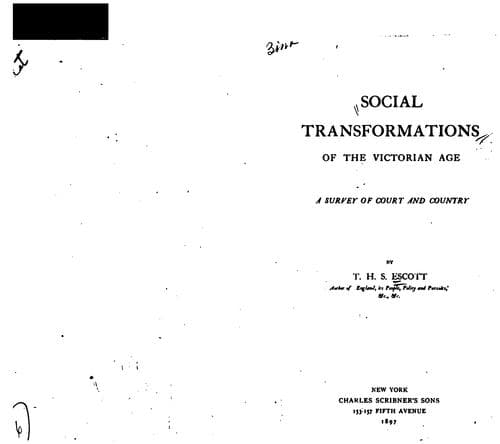
Social Transformations of the Victorian Age: A Survey of Court and CountryEscott, T. H. S. (Thomas Hay Sweet)
History
Social Transformations of the Victorian Age: A Survey of Court and Country
Escott, T. H. S. (Thomas Hay Sweet)
Great Britain -- Civilization -- 19th century; Great Britain -- Social life and customs -- 19th century
The name of Her Majesty written in the clear bold hand of youth when she
became Queen may be read to-day in the register of the Royal Society. That
entry prefigured the close connection between science and the Court which,
for the first time in the history of the monarchy, was to signalize her
reign. The period preparatory to the enthronement of science and art
beneath the glass roof of Paxton was of scarcely less educational value to
the Kingdom than, to most appliances of daily life, the Exhibition itself
was to prove. The instructive addresses delivered at this time by the
Prince Consort, now to a gathering of artists and writers, now to more
popular audiences at Birmingham or elsewhere, may seem to those who read
them to-day familiar or even commonplace. They were then entire novelties,
not only from their authorship, but from their subject.
In 1897 it appears the most natural and suitable thing in the world that a
Royal Prince should vary the more strictly ceremonial functions of State
by opening an art gallery in London, a science school in the provinces, an
Imperial Institute, a Fisheries Exhibition in South Kensington. Fifty
years since such a part seemed of questionable wisdom to some, of
dangerous precedent for the monarchy to others; at the best a foreign
experiment which the Queen's husband would most wisely have left unmade.
In the sixtieth year of the reign, there is no social gathering or private
dwelling, there is scarcely a village inn, or country cottage, or a
seaside lodging house, that by the paper on its walls, the designs of its
furniture, the suspended pictures cut from illustrated prints, fails to
remind one with eyes to see such things the extent to which ideas of art
or ornament that began with the Prince and Sir Henry Cole have directly
from South Kensington penetrated into every corner of the land, and made
their humanizing influence felt beneath the roof of peasant as well as of
peer.
Even in the thirtieth year of the reign, these forces had scarcely
advanced beyond the embryonic stage. Had the Prince Consort himself
claimed visibly to exercise the Royal prerogative, on which as a fact he
never presumed, he could scarcely have given a greater shock to the
prejudices of those high in social position and near the Court who
inherited from Hanoverian times a contempt for all distinctions save those
of birth and rank.
Public-domain text, read in full here on John Shaqi.
Reviews
Reviews
No reviews yet
Be the first to share your thoughts on this work.
Elsewhere in the archive
Join the Discussion
Join the discussion
Sign in to leave a comment or review.
Sign InorCreate an account