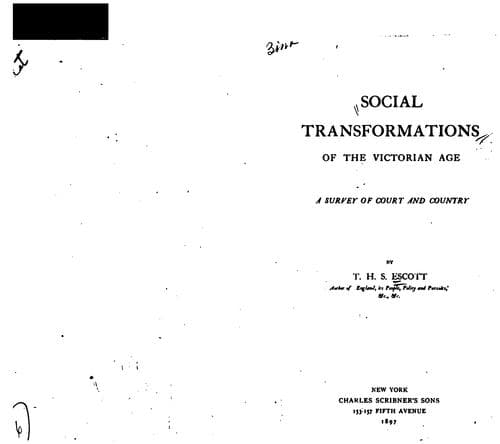
Social Transformations of the Victorian Age: A Survey of Court and CountryEscott, T. H. S. (Thomas Hay Sweet)
History
Social Transformations of the Victorian Age: A Survey of Court and Country
Escott, T. H. S. (Thomas Hay Sweet)
Great Britain -- Civilization -- 19th century; Great Britain -- Social life and customs -- 19th century
Up to the moment of his death the Queen's husband was endeavouring to make
his wife's Court a centre not only of achievement in war, of statesmanship
in peace, but of letters, art, science, and of the most famous among their
contemporary ornaments. Death prevented the design from ever being carried
out completely. The names of Alfred Tennyson and of Arthur Penrhyn Stanley
are enough to remind one of the direction actually travelled by the Prince
in producing some resemblance between the Windsor where a Victoria
reigned, and the Weimar whose intellectual glories, a Goethe had typified.
Here again the intellectual revolution which the Court began has been
continued by those who represent the Crown to-day.
Such knowledge of physical science as the Prince Consort's son possesses
was largely imparted to him by the teacher Faraday, who was his father's
choice. Appropriately enough, therefore, in the winter of 1897 did the
Prince of Wales assist in founding the Faraday Laboratory of the Royal
Society. The progress now spoken of seems to be symbolized by the
acceptance of the word 'science' as the nearly exclusive synonym for that
physicism which is strictly only one of the divisions that generically it
includes. From the check to the regular teaching of physical knowledge at
the disorganization spread through the world by the collapse of the Roman
Empire, and by the concentration of human thought upon politics and
theology, instead of those subjects first expounded by Thales, after him
by Archimedes, Aristotle, Ptolemy, till the day of the modern doctors had
dawned, the conquests achieved by man over nature were inconsiderable.
Francis Bacon's equalization of human _ingenia_, and his elaborately
tabulated apparatus for studying phenomena, created an appetite for
mastering the arcana of the visible universe, but did not satisfy it. As
the Prince Consort clearly saw, Nature's secret had been yielded in the
past, and would be surrendered in the future, not to founders of systems
like a Verulam or a Descartes, but to actual discoverers who did not owe
even their methods to the Schools.
Public-domain text, read in full here on John Shaqi.
Reviews
Reviews
No reviews yet
Be the first to share your thoughts on this work.
Elsewhere in the archive
Join the Discussion
Join the discussion
Sign in to leave a comment or review.
Sign InorCreate an account