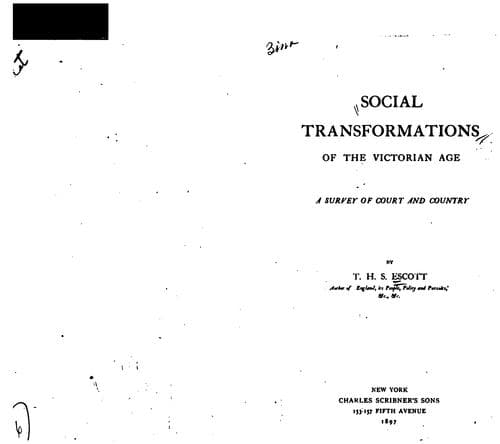
Social Transformations of the Victorian Age: A Survey of Court and CountryEscott, T. H. S. (Thomas Hay Sweet)
History
Social Transformations of the Victorian Age: A Survey of Court and Country
Escott, T. H. S. (Thomas Hay Sweet)
Great Britain -- Civilization -- 19th century; Great Britain -- Social life and customs -- 19th century
Half a century after Bacon's labours, Newton, with no help from Baconian
methods discovered the law of gravitation, and with it the unity of
sequences which pervade material creation. The cause of the slight
progress of physical science whether before or immediately after Bacon
formulated his method may be partly explained by the want of the material
appliances for physical investigation. These in anything like their
mechanical perfection of to-day are not much older than our present era.
The agencies of glass, of alcohol, of microscopes and of other such
appliances were as unknown to the physicists of Alexandria, of Athens, or
of the Middle Ages as the electric wire itself. Where the subject matter,
the heavenly bodies, the structure of the human frame, could be studied
without elaborate machinery, the contemporaries or successors of the
Ionian physicists who searched for the origin of all things in some single
element, air, fire or water, seem rudely to have anticipated later
discoveries. The Aristotelian philosophy and the rudiments of practical
medicine, preserved together by Averrhoes, Avicenna, and the whole school
of the Arabian thinkers of the twelfth and thirteenth centuries, descended
in each other's company to the Italian schoolmen, and were delivered by
them to English students. Thus, on the eve of the present century, the
indestructibility of matter, however Protean the forms of its
manifestations, had been ascertained by European chemists. The year of the
Queen's accession was also that of the publication of Whewell's _History
of the Inductive Sciences_.
In this age, as in that of Bacon, great lawyers have taken a foremost
place among enquirers into the nature of things. Lord Brougham did
something to methodize, and more to popularize, the facts of science. A
greater lawyer than Brougham, Sir William Grove, Justice of the Common
Pleas first, Judge of the High Court of Justice afterwards, was also
professor of experimental philosophy at the London Institution during the
first decade of the reign. His discoveries with regard to the correlation
of forces had not been entirely formulated when Dr Whewell's book
appeared. Nor had Charles Darwin completed in his retirement at Down, in
Kent, those researches which in 1859, gave the world _The Origin of
Species_. This book, if the work of any single man ever did so, created an
epoch, not in physical enquiry alone, but in every branch of human
knowledge conducted on scientific principles.
Public-domain text, read in full here on John Shaqi.
Reviews
Reviews
No reviews yet
Be the first to share your thoughts on this work.
Elsewhere in the archive
Join the Discussion
Join the discussion
Sign in to leave a comment or review.
Sign InorCreate an account