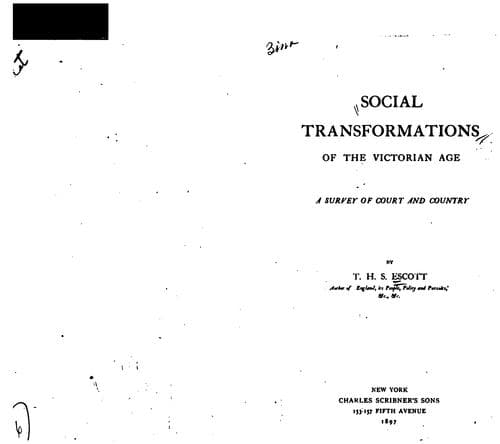
Social Transformations of the Victorian Age: A Survey of Court and CountryEscott, T. H. S. (Thomas Hay Sweet)
History
Social Transformations of the Victorian Age: A Survey of Court and Country
Escott, T. H. S. (Thomas Hay Sweet)
Great Britain -- Civilization -- 19th century; Great Britain -- Social life and customs -- 19th century
Charles Hallé, born in Westphalia in 1819, and so just ten years younger
than Mendelssohn was driven from Paris to London by the Revolution of
1848, to which England was indebted for such an influx of foreign genius
of all kinds to her shores. Beethoven, like Handel, first became known in
Europe through a German Elector, him of Cologne. He died in 1827. Though
the charm and fame of Beethoven had been steadily growing upon English
critics and musicians first and upon the general public afterwards, to
Charles Hallé[79] belongs the distinction of having done much towards
popularizing this great author of classical music with the English public.
The Musical Union which preceded the Popular Concerts was then directed by
John Ella, whose programmes included Beethoven's sonatas, played by Hallé
with great applause.
The English public, if by voluntary culture it had not been disciplined
into a genuine admiration for Teutonic music, as interpreted by various
foreign executants, would have been wooed to its love by the educating
influences of the Hungarian violinist Herr Joachim, deservedly reverenced
by all circles of English society, ever receiving his homage with the
dignified modesty of great genius. This director of the Royal Academy of
Music at Berlin had, before that appointment, received the degree of
Doctor of Music at Cambridge. The bow with which he elicited entrancing
strains from his instrument was a social sceptre as well. When George
Eliot was writing _Daniel Deronda_, Herr Joachim's social and artistic
ascendancy had just reached its culminating point. A scientific musician
herself, George Eliot visited those circles where first-rate music was to
be heard. No writer more artistically found the suggestions of her
characters in real life. The Herr Joachim whom English society knew is
reflected so strikingly in the Herr Klesmer of whom the _Daniel Deronda_
public reads as to warrant the conjecture that the master before whom
Gwendolen Harleth trembled had been suggested by the violinist at whose
feet the aristocracy of birth, beauty, wit, intellect and wealth with
unfeigned admiration knelt down.
Other individuals deserve a place in the catalogue of those who have
helped on the musical movement of our times. Sir George Grove made a
substantial addition to the musical wealth of the world by contributing a
chapter to its musical romance; that which relates his discovery of the
lost scores of Schubert in a Vienna cupboard. His dictionary of music will
survive when the honourable record of his Directorship of the Royal
College of Music may be forgotten. Sir Arthur Sullivan has not only
illustrated with melodies, that have at once caught the ear of the town,
the fantastic conceptions of Mr W. S. Gilbert's intellect; he has used his
personal popularity on all levels of social London to diffuse improved
notions of musical taste. Agencies of the same kind, collective as well as
individual have not, during the Victorian age, been wanting.
Public-domain text, read in full here on John Shaqi.
Reviews
Reviews
No reviews yet
Be the first to share your thoughts on this work.
Elsewhere in the archive
Join the Discussion
Join the discussion
Sign in to leave a comment or review.
Sign InorCreate an account