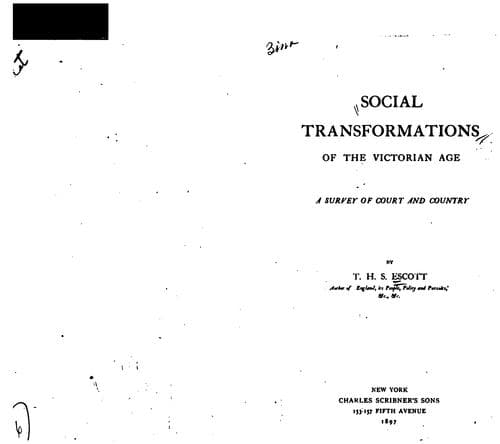
Social Transformations of the Victorian Age: A Survey of Court and CountryEscott, T. H. S. (Thomas Hay Sweet)
History
Social Transformations of the Victorian Age: A Survey of Court and Country
Escott, T. H. S. (Thomas Hay Sweet)
Great Britain -- Civilization -- 19th century; Great Britain -- Social life and customs -- 19th century
The _personnel_ of upper middle class society in England has been
perceptibly affected by the entrance into it through the gate of marriage,
of ladies of German origin, of great taste and accomplishments generally,
and like all their nation, devoted to music. Hence among other things the
increased patronage of the Italian Opera, of all high-class concerts in
public as well as of musical artists in private by that well to do section
of the Queen's subjects which combines the tastes of culture and of birth
with the resources of trade. Its composition of the veritable materials of
Paxton's Glass House for the Great Exhibition is not the only respect in
which the Crystal Palace at Sydenham is connected with that enterprise of
the Prince Consort as a reformer of English taste. To mention only its
connection with the subject now being specially considered, the Crystal
Palace has maintained its full orchestra since 1854. These concerts have
been admittedly during near half a century prime instruments of
metropolitan and suburban civilization. They have practically
revolutionized the home life of tens of thousands of the prosperous
commercial class which fixes its household gods out of earshot of Bow
Bells. The impulse thus given to the study of the art on a basis wider and
deeper than anything formerly existing can scarcely be exaggerated. It is
of itself enough to explain why the number of English students of music in
the nineties is so vastly larger than it was during any of the preceding
decades.[80]
CHAPTER XXV
TRANSFORMED AND TRANSFORMING ART
English art stimulated and strengthened to a degree second only to
science by the movements with which, through the Prince Consort, the
Victorian Court identified itself. Contrast between the social
consideration of artists now and fifty years ago. From Gandish to
Gaston Phoebus. Progress in the association of art with the government
of England, and general gain to all concerned in consequence. Gradual
endowment of art by the State and establishment of the existing
machinery for teaching art and displaying its triumphs to a cultivated
public. The work of South Kensington. Success of the Academy tested by
figures and facts. Reciprocal benefits to art workers and art patrons.
Foreign recognition of English art. The past, present and future of
English sculpture.
Public-domain text, read in full here on John Shaqi.
Reviews
Reviews
No reviews yet
Be the first to share your thoughts on this work.
Elsewhere in the archive
Join the Discussion
Join the discussion
Sign in to leave a comment or review.
Sign InorCreate an account