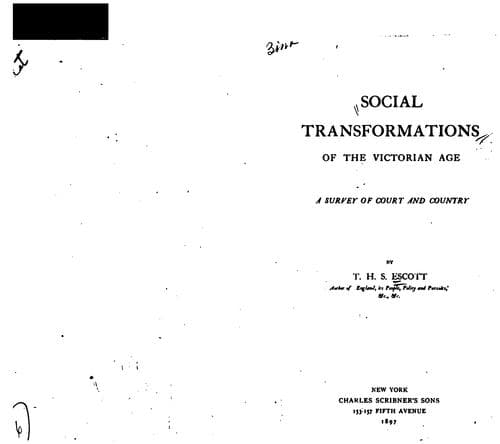
Social Transformations of the Victorian Age: A Survey of Court and CountryEscott, T. H. S. (Thomas Hay Sweet)
History
Social Transformations of the Victorian Age: A Survey of Court and Country
Escott, T. H. S. (Thomas Hay Sweet)
Great Britain -- Civilization -- 19th century; Great Britain -- Social life and customs -- 19th century
The popularization and improvement of art in all its manifestations
followed the 1851 Exhibition and the initiative of the Prince Consort in a
degree second only to the development of science and music themselves.
That the Court of Victoria and Albert should have been to the painters of
a later day what the Court of Charles I. was to Van Dyck could not have
been expected. The Consort's interest and judgment in pictures were
inferior to his genuine concern for science. The complacency with which he
regarded the canvases of Winterhalter could not promise much enthusiasm in
the patronage of English painters. His rescue from disorder and decay of
the Raphael cartoons, long before the Prince's day belonging to our
Court, but by him first properly cared for and arranged, was not a work of
creation, but was one of artistic development. His were the active mind
and useful hand that rendered available for national instruction or
delight the hereditary treasures of Crown and country which before his day
were not indeed unknown, but were not perhaps properly appreciated in the
country which possessed them. The rise of a moneyed and fairly cultivated
class in English society was the chief element in the improvement of the
social and commercial position of the English painter. These agencies
happily coincided with the example set by the Prince to his successors of
assisting at the great artistic gatherings of the year.
Before May 3, 1851, the Crown had not been represented at the Royal
Academy dinner. It has seldom been unrepresented since. Sir Charles
Eastlake, in whose election to the Presidency the Queen and Prince had
been much interested, had not brought oratorical euphuism to the same
perfection as his successor, Lord Leighton. He was, however, a man of
cultivated mind, of acceptable presence, and of well-bred speech. His
proposal of the Prince's health was made in words that have to-day an
historical value. The reply of the Prince blended a philosophic criticism
less English than German, with an appreciation of our national masters
which was entirely patriotic. It was, he said, the fate of all
aristocracies to be assailed habitually from without, sometimes from
within. The Academy being an aristocracy of the brush, must accept the
position and turn to practical account any hints for improvement which it
might contain.[81]
Public-domain text, read in full here on John Shaqi.
Reviews
Reviews
No reviews yet
Be the first to share your thoughts on this work.
Elsewhere in the archive
Join the Discussion
Join the discussion
Sign in to leave a comment or review.
Sign InorCreate an account