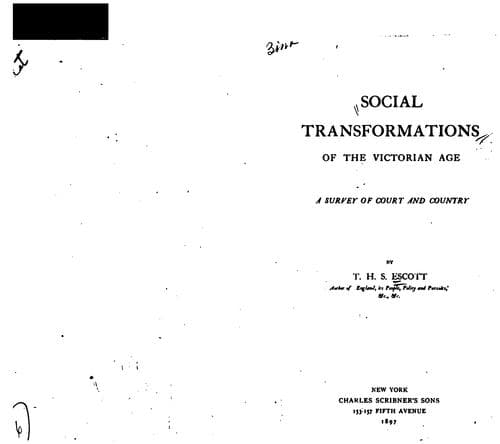
Social Transformations of the Victorian Age: A Survey of Court and CountryEscott, T. H. S. (Thomas Hay Sweet)
History
Social Transformations of the Victorian Age: A Survey of Court and Country
Escott, T. H. S. (Thomas Hay Sweet)
Great Britain -- Civilization -- 19th century; Great Britain -- Social life and customs -- 19th century
Sir John Potter, the father of the present Mr T. B. Potter, took the
chair. On the platform among the speakers were John Bright, Bulwer Lytton,
Sir James Stephen, the future Lord Houghton, Dickens and Thackeray;
Charles Dickens made a speech in his happiest, and therefore incomparable,
vein, on the Manchester School, an expression then in many mouths. The
success of the experiment first illustrated on the Irwell was gradual. The
provinces led the way which at last the capital followed. So late as 1886,
only two parishes out of the sixty-seven within the metropolitan area had
adopted the Acts. By August 1891 this number had risen to thirty. Other
London districts have since followed.[87] With time the result has been
more than satisfactory. In the manner already seen it has affected the
life and appearance of every town in the country, and has certainly
provided a machinery without which as a supplement the educational
apparatus of free schools would do little.
To-day, therefore, in any large district, London or provincial, it is the
exception for the Free Libraries Act not to be operative. That the power
to read and the taste for reading does not always make good citizens, is
of course true enough. On the other hand the close connection between
ignorance and crime is instructively shown by a few historic statistics
cited by Mr T. Greenwood, in his valuable volume on _Public Libraries_.
These figures are to the following effect.
In 1856 the number of young persons committed for indictable offences was
14,000. In 1866, when the State had, by the action of the Privy Council,
since 1833 assumed educational responsibility, and cheap literature of the
better sort had, thanks to Charles Knight, and his many public-spirited
imitators, become general, the number was decreased to 10,000. When School
Boards were fully at work, there was a yet further reduction to 7,000; and
this though the population had risen from 19 to 27 millions. Passing to a
later date, out of 164,000 persons in prison between the years 1880-90,
60,000 were entirely uneducated. Nor is it less suggestive that since the
teaching of the people was seriously taken in hand by the State in 1870,
no new prison has been built; while several buildings which were prisons
have been changed into public libraries, or, as in the case of Milbank,
have been converted into a fine art gallery.
Public-domain text, read in full here on John Shaqi.
Reviews
Reviews
No reviews yet
Be the first to share your thoughts on this work.
Elsewhere in the archive
Join the Discussion
Join the discussion
Sign in to leave a comment or review.
Sign InorCreate an account