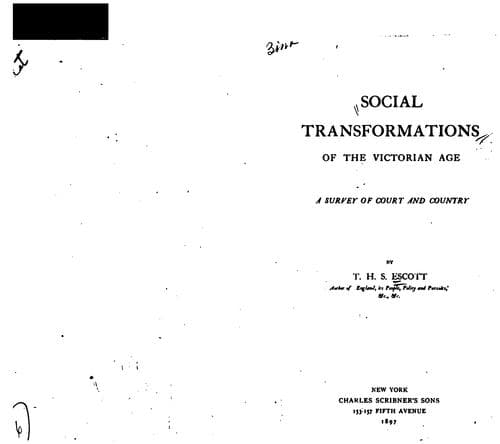
Social Transformations of the Victorian Age: A Survey of Court and CountryEscott, T. H. S. (Thomas Hay Sweet)
History
Social Transformations of the Victorian Age: A Survey of Court and Country
Escott, T. H. S. (Thomas Hay Sweet)
Great Britain -- Civilization -- 19th century; Great Britain -- Social life and customs -- 19th century
The Jubilee Year of 1887 witnessed the completion of a revolution in the
public press, that had in fact begun a twelvemonth earlier. Hitherto the
great London broadsheets had either been affected really if not
professedly to one of the great political parties; or had, as in the case
of the _Times_, not less than of the chief weekly journals, made some show
of impartially criticizing both parties alike. In 1886 the Liberal party
was rent in twain by the Irish policy of its greatest member. The result
with the press was to divest political writers of all show of
independence. Those journals which accepted the great leader's view were
converted into uncompromising champions of the scheme that their opponents
said would dismember the monarchy. Those, on the other hand, which
resisted the great statesman's plan found themselves by the force of
events they could not control detached from their earlier traditions of
independence and converted into the enemies of political Liberalism not
only on one issue, but on all.
From that day newspaper criticism of men and measures has practically
ceased. With a few able exceptions, signally that of the _Daily
Chronicle_, the paramount task of the press in the sixth decade of the
epoch is to support a combination of groups rallied not under a party
flag, but an Imperial banner. About the same time another newspaper change
may be said to have taken place. Hitherto, the anonymous system had been
fairly preserved. The names of newspaper writers were not known beyond
their office, or at least beyond Fleet Street. Now, however, English
journalism was undergoing two distinct and mutually antagonistic
processes. On the one hand it had by the agency of the great newspapers
with their enlarged staffs and various departments been organized into a
liberal profession, attracting specialists of all kinds to its columns. On
the other hand its pleasures and its profits had gathered a host of camp
followers who as amateurs vied with the older professionals. Next, persons
of fashion or of quality took to the proprietorship or editorship of new
journals, as, till then, they had taken to the owning and management of
theatres for the benefit of personal friends. In _Lothair_, someone
advises the hero to amuse himself with theatre proprietorship 'as being
the high mode for all swells.' The paper next enjoyed the same vogue as
the playhouse.
Public-domain text, read in full here on John Shaqi.
Reviews
Reviews
No reviews yet
Be the first to share your thoughts on this work.
Elsewhere in the archive
Join the Discussion
Join the discussion
Sign in to leave a comment or review.
Sign InorCreate an account