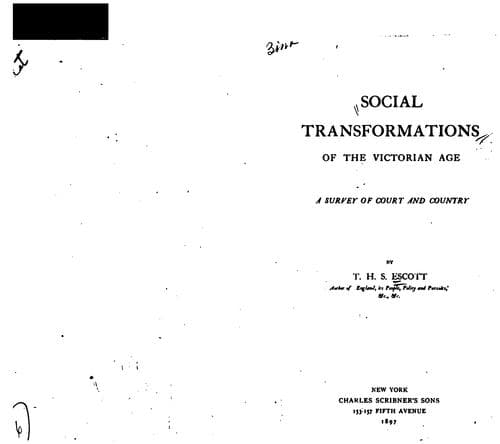
Social Transformations of the Victorian Age: A Survey of Court and CountryEscott, T. H. S. (Thomas Hay Sweet)
History
Social Transformations of the Victorian Age: A Survey of Court and Country
Escott, T. H. S. (Thomas Hay Sweet)
Great Britain -- Civilization -- 19th century; Great Britain -- Social life and customs -- 19th century
The former secrecy now became impracticable. As had long been the case
with the monthly periodical, the weekly print first and the daily print
afterwards showed a tendency towards a transformation from an organ of
collective opinion into a platform for individual display. The new
editor's chief business was not as formerly to point the gun for the
marksmen of the pen to fire, but to recruit writers with well known names.
If their signatures were suppressed, the authorship, as it was intended it
should do, speedily transpired. Fleet Street became a whispering gallery
of press gossip. Its murmurs were heard throughout the land.
What the sixpenny magazine is to the monthly press that the halfpenny
newspaper is to the daily. The first daily journal at this price, the
_Echo_, after some startling vicissitudes came into the capable hands of
John Passmore Edwards, a Celt of Cornwall with all the characteristics of
his race. Morning as well as evening rivals at the same price sprung up
like mushrooms after rain. _Evening News_ or _Star_ at night, the
_Morning_, the _Leader_ are only a few of the fresh notes added to the
music of the London street vendors. No urchin so ragged that he does not
proclaim the printed wares of a millionaire _in esse_ or _in posse_.
Believers in literature as part of popular education will think it a good
sign that book reviews, and articles of a kindred sort are features in
characteristically Victorian newspapers. Signally in the arrangements for
supply of foreign news, a revolution extending throughout the whole press
of the country has been effected by the enterprise of these journals. The
telegrams on which for its tidings from abroad the public used exclusively
to depend, have been often superseded by the dispatches of special
representatives of their journal stationed abroad.
Every journal has now become its own Reuter. Men like Alfred C.
Harmsworth, being millionaires as well as resourceful journalists, thought
no more of having their own agents in every capital at the end of a
telegraphic wire than of arranging a little Arctic expedition on their own
account. They have thus forced the hand of newspaper proprietors all
round. The leisurely descriptive writing has gone out. The condensed
three-line paragraph has come in. The _Daily Mail_ has shown a busy
generation which reads its papers as it takes its lunch standing at a
buffet, that the essence of the day's news of the world can be read in a
few odd minutes as easily as the _Iliad_ and the _Odyssey_ were once
packed into a nutshell.[96]
For this new journalism new men have been needed. In most cases very young
men; generally fresh from Balliol or Trinity where they have perhaps won
Fellowships as well as First Classes, but in appearance often not much
older than a public school sixth form boy. Youth is an error which
unfortunately time too soon corrects.
Public-domain text, read in full here on John Shaqi.
Reviews
Reviews
No reviews yet
Be the first to share your thoughts on this work.
Elsewhere in the archive
Join the Discussion
Join the discussion
Sign in to leave a comment or review.
Sign InorCreate an account