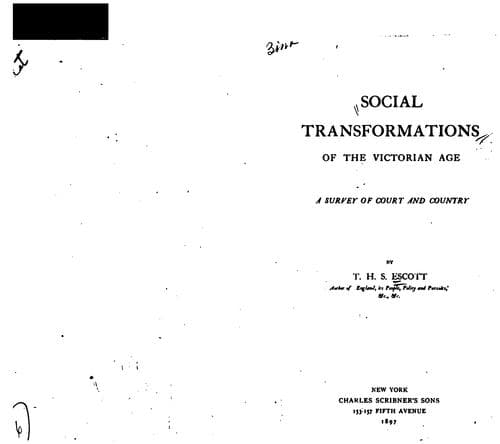
Social Transformations of the Victorian Age: A Survey of Court and CountryEscott, T. H. S. (Thomas Hay Sweet)
History
Social Transformations of the Victorian Age: A Survey of Court and Country
Escott, T. H. S. (Thomas Hay Sweet)
Great Britain -- Civilization -- 19th century; Great Britain -- Social life and customs -- 19th century
In ability, in conscientious use of increased power; in education, in
social position, in all the best guarantees of responsibility, the British
press has improved immeasurably within the present age. Even now it shows
signs of perceiving that a certain amount of political impartiality
towards the great leaders of State and Church renders its praise, its
censure, and its criticism the more effective because the less mechanical.
The condition of things which has made so many great newspapers patriotic
partizans instead of independent guides must in its nature be temporary.
When it has gone by, and a more normal state of affairs is re-established,
there will be perhaps no compensating disadvantages to the increasing
influence with which the Victorian age has endowed and is yet endowing
what is really a fourth estate.[97]
CHAPTER XXVIII
TRANSFORMATIONS IN INVALID LIFE
Legislation for the helpless in health or in sickness the exclusive
feature of the Victorian age. Early interest of the English Court
through the Prince Consort in the housing of the poor. This coincided
with, and helped forward, the organized public movements for popular
sanitation. General summary of these, as shown by results. The new
nurse contrasted with the old. Hospitals to-day twice blessed.
Specific progress of sanitary reform. Demonstrable connection between
these improvements and figures of the death rate. Preventive and
curative medicine also entitled to credit. General course of medical
progress. Special researches of English physicians. Their ascertained
usefulness and their latest aspects. Improvement in English doctors,
with particular instances.
Before the Victorian age, there had been no legislation for the purpose of
helping the helpless, housing the homeless, providing for the health of
those whose birth-right was the squalor, the starvation, the disease, that
come from systematic neglect. Here, as in other things, the representative
of the Crown, transformed from a political power into an agency of social
good, led the way. The Prince Consort, moved by the condition and by the
address of the ballast heavers in the East End of London took the
initiative; the legislature gradually followed. Thus was the principle
established and acted on that one of the prime duties of the State is to
those for whom from any other quarter there is no help.
Public-domain text, read in full here on John Shaqi.
Reviews
Reviews
No reviews yet
Be the first to share your thoughts on this work.
Elsewhere in the archive
Join the Discussion
Join the discussion
Sign in to leave a comment or review.
Sign InorCreate an account