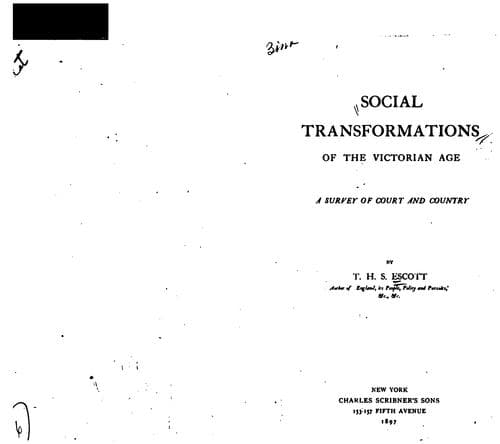
Social Transformations of the Victorian Age: A Survey of Court and CountryEscott, T. H. S. (Thomas Hay Sweet)
History
Social Transformations of the Victorian Age: A Survey of Court and Country
Escott, T. H. S. (Thomas Hay Sweet)
Great Britain -- Civilization -- 19th century; Great Britain -- Social life and customs -- 19th century
The last instance of that wholesome truth was the Dilke Commission for the
better housing of the poor aptly presided over by the Prince Consort's
eldest son in 1885. Exactly forty-five years earlier than this, Colonel
Slaney's[98] motion in the House of Commons produced an enquiry into the
health of towns. Local Improvement Acts had been multiplied to the number
of 500. There was still no proper drainage. The Duke of Buccleuch's
Commission of 1848 led to the Public Health Act of the same year. As the
cholera invasions of 1853 and of 1865-6 showed, the Local Boards
established by the Act of 1848 were too permissive in their operations to
be fully effective. Edwin Chadwick, and Southwood Smith had from the first
co-operated with the Queen's husband. Their activity did not cease when
the earliest steps to reform had been taken: 1858 witnessed fresh
improvements.[99]
It was not till 1875 that the confused mass of sanitary laws was
consolidated. Then the Local Government Board which, with the powers of
the superseded Poor Law Board, had been established in 1871 was in full
and in most beneficent work. Still the Commission that last investigated
the matter, due as it was largely to Lord Shaftesbury, showed many evils
still to remain. Overcrowding was worse in the West London rookeries than
it had been in the East. In 1885 the Dilke Commission Act gave fresh power
to local authorities to destroy unhealthy dwellings.
The machinery which thus exists as the sixth decade of our epoch draws to
its close, is therefore tolerably complete. Guarantees for its promptly
being put into motion are still wanted. Not only the credit, but the very
conception of this wholesome function of the State belongs entirely to our
era, and arises out of the enlarged idea of Royal service which fills the
modern mind.
Strictly consistent with family tradition is the effort of the Prince of
Wales to help those who are only one degree more helpless than the
dwellers in city and suburban alleys and courts in time of need. To free
the London hospitals of debt will crown the edifice of sick relief that in
Crimean days the Queen and her husband began.
From the departure of Miss Florence Nightingale[100] and her trained staff
for the Crimea in 1854 must be dated the birth of nursing as a polite
profession. But for that mission of mercy one would hear nothing of the
contemporary parade of nurses in the height of the London season in the
grounds of Marlborough House. The fashionable vogue of the vocation may
sometimes attract modish recruits who have not counted the cost.
Public-domain text, read in full here on John Shaqi.
Reviews
Reviews
No reviews yet
Be the first to share your thoughts on this work.
Elsewhere in the archive
Join the Discussion
Join the discussion
Sign in to leave a comment or review.
Sign InorCreate an account