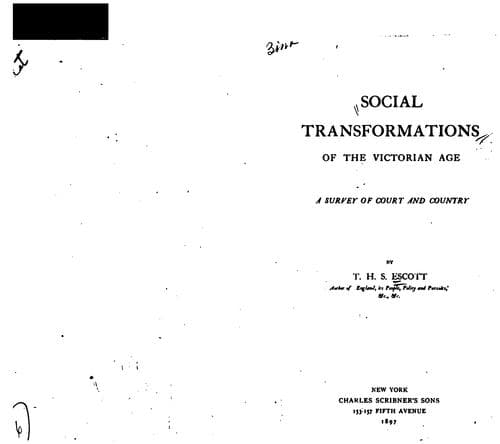
Social Transformations of the Victorian Age: A Survey of Court and CountryEscott, T. H. S. (Thomas Hay Sweet)
History
Social Transformations of the Victorian Age: A Survey of Court and Country
Escott, T. H. S. (Thomas Hay Sweet)
Great Britain -- Civilization -- 19th century; Great Britain -- Social life and customs -- 19th century
Amiable sympathy is not the sole qualification which the lady nurse needs.
Self-consciousness is as much a disqualification as a shuddering dislike
of sick room scenes. It is also the attribute that the patient is the most
quick to observe. Not a few of the sick whom the ministering angel of the
new school desires to relieve may still sigh for the presence by their
bedside of the displaced Mrs Gamp instead of the young lady in the
coquettish muslin cap and dainty grey frock who casts complacent glances
at herself as she passes the mirror, and with an air not quite suited for
a sick room offers her patient his medicine or his barley water as if she
were suggesting black coffee, green Chartreuse, and a cigarette after a
whitebait dinner. These defects will no doubt be mended when the lady
nurse is more habituated to her calling. Decayed billiard markers, and
scripture readers who have gone wrong, will not eventually figure so
largely among the self-sacrificing males who also find their career in
tending the invalid. The scandals of which the nurse (old style) was
sometimes the heroine still live in the pages of Dickens. They arose from
the rumoured hastening of the sick man's death by the scriptural practice
of laying a wet cloth over his mouth. Any scandals with which the nurse
(new style) might be connected would perhaps come from the desirable
marriage that she arranges for herself in the sick room or from the
legacies made to her by grateful patients, but disputed by thankless
relations. These things, therefore, should be no doubt regarded not as
slurs upon her disinterestedness, but as tributes to her efficiency.
Inside the hospital the same transformation has been effected as in the
aspect of the ministering angels themselves. The grave young gentlemen in
training for the medical profession have nothing about them left of the
lamp breaking, policemen baiting, medical student of Albert Smith. If
sometimes one reads of the too engrossing attractions for these youths of
the sylphs who flit to and fro in the wards, the answer is obvious--'Evil
be to him who evil thinks.'
Public-domain text, read in full here on John Shaqi.
Reviews
Reviews
No reviews yet
Be the first to share your thoughts on this work.
Elsewhere in the archive
Join the Discussion
Join the discussion
Sign in to leave a comment or review.
Sign InorCreate an account