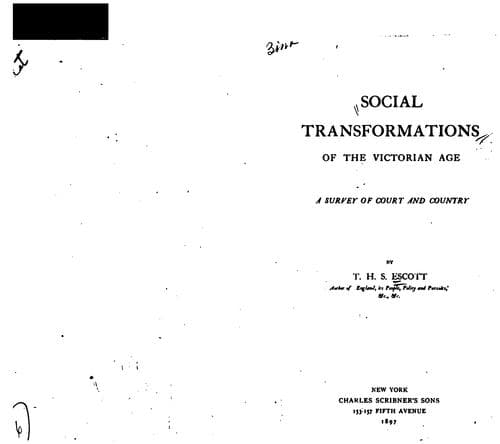
Social Transformations of the Victorian Age: A Survey of Court and CountryEscott, T. H. S. (Thomas Hay Sweet)
History
Social Transformations of the Victorian Age: A Survey of Court and Country
Escott, T. H. S. (Thomas Hay Sweet)
Great Britain -- Civilization -- 19th century; Great Britain -- Social life and customs -- 19th century
Hospital management is the subject not for a few pages in a single book,
but for a library in itself. One or two not controversial facts may be
given. Throughout the Victorian age a marked feature in medical charities
has been the supplementing of the historic hospitals with many new
dispensaries and establishments for special diseases. If the latest
hospital endowments are smaller than those originating in an earlier
century, the explanation is less a decline in eleemosynary purpose or
power than the development of the value of the property assigned to the
older foundations.[101] Thus the revenue of St Bartholomew's in the middle
of the sixteenth century seems to have been only £371 a year. Towards the
close of the nineteenth century it is £32,000 a year. During our own era
hospital benefactions approaching a quarter of a million are far from
unknown. These do not include such special and comparatively recent
hospitals as that for consumption, with the 40 new dispensaries connected
with it.
To epitomize the facts; the total of London hospitals or infirmaries with
wards for the sick amounts to 49. The movement still goes forward. So vast
is the scale on which these buildings, less houses than towns in
themselves, were first planned that in many of them there is yet room for
fresh beds. This is only a specimen of what has been, and is being, done
throughout the kingdom. There thus seems a fresh argument in favour of
continuing to London itself an institution like St Thomas's, Southwark,
the removal of which to the country was not long since suggested.
Like all gracious works, these places are twice blessed. They relieve
those who are in need. They humanize those whom prosperity and comfort
might make callous. Before our age began, no one thought of sending game
or fruit to the sufferers or convalescents within these places of refuge.
Now it is the exception for the millionaire not to make the spoils of his
fashionable battue pay tithe to those for whom such food is often the best
of physic. The costly flowers that decorate the drawing rooms or dining
rooms during the season are not discarded as rubbish when the festivity is
over. They are scrupulously tended so as not to lose their freshness.
Presently their hues and fragrance will relieve the bleak expanse of
white-washed wall in those places where our sick are nursed away from
their own homes.[102]
* * * * *
The contrasts of our age include a marked connection between the
organization of the healing art and the advance of medical science on the
one hand and the reduction of the death rate on the other. In 1855 the
mortality of the United Kingdom was 23 per 1,000. In 1875 it was 21 per
1,000. In 1895 it had fallen to 18 per 1,000. The figures,[103] and the
conclusions to which they point, are tributes, not only to medical skill
in healing disease, but to sanitary reform in preventing it.
Public-domain text, read in full here on John Shaqi.
Reviews
Reviews
No reviews yet
Be the first to share your thoughts on this work.
Elsewhere in the archive
Join the Discussion
Join the discussion
Sign in to leave a comment or review.
Sign InorCreate an account