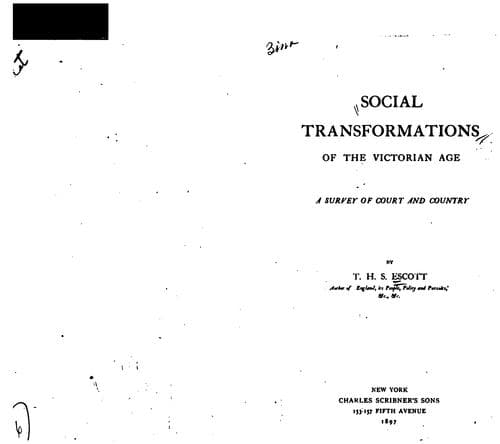
Social Transformations of the Victorian Age: A Survey of Court and CountryEscott, T. H. S. (Thomas Hay Sweet)
History
Social Transformations of the Victorian Age: A Survey of Court and Country
Escott, T. H. S. (Thomas Hay Sweet)
Great Britain -- Civilization -- 19th century; Great Britain -- Social life and customs -- 19th century
Before the Victorian age began the whole population of these Islands
awaited the periodical onsets of pestilence with the resigned fatalism of
the Turk, or with the passive submission of latter day London to the
incubus of snow. The notorious consequences of unhealthy living prompted
no preventive measures. Divine wrath was believed to express itself in
deadly epidemics. When that anger was assuaged health would return. Till
then human remedies could do little. Meanwhile, the truth that Providence
helps those who help themselves was being scientifically shown. Hence in
1838, a State enquiry into the whole matter was instituted. In 1848 the
legislation began which, by promoting cleanliness, at once disarmed
disease. John Simon proved the propagation of pestilence to proceed by
impure particles. In 1858-65, on his initiative, the Government
strengthened the defences of public health. The entrance of foreign
plagues was stopped at our ports. Three sons of a clever West of England
doctor named Budd[104] had been trained from their childhood in practical
medicine by their father. These doctors showed the connection between
impure water and typhoid fever, as before them Snow had shown between
cholera and water. When the improvements suggested by these researches
were adopted health generally benefited. Consumption statistics became
less alarming every year. Fevers of all kinds were successfully combated.
Since vaccination had become general, smallpox cases had fallen by at
least one-half.
Meanwhile, the discovery of anæsthetics, of chloroform by Professor J. Y.
Simpson of Edinburgh in 1848, of ether in 1846 by Morton and Robinson of
the United States, at once robbed surgical operations of their terrors,
and rendered them practicable in cases where till then they could not
safely be tried. In 1860 came the antiseptic treatment of Sir Joseph,
since Lord, Lister. Before then, the nervous system had been explored
successfully by Carpenter.[105] Instruments for examining by reflected
lights the hidden parts of the human frame had been invented by several
English surgeons. Operations for certain internal tumours, that had
hitherto defied removal, were first performed by Cæsar Hawkins, born 1798,
brother of the famous Oriel Provost, a pupil of Brodie at St George's; and
more recently by Spencer Wells.
Public-domain text, read in full here on John Shaqi.
Reviews
Reviews
No reviews yet
Be the first to share your thoughts on this work.
Elsewhere in the archive
Join the Discussion
Join the discussion
Sign in to leave a comment or review.
Sign InorCreate an account