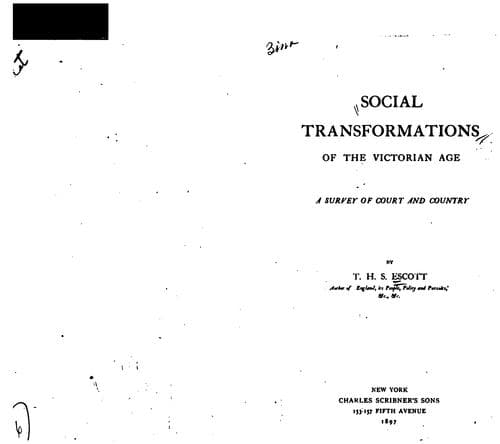
Social Transformations of the Victorian Age: A Survey of Court and CountryEscott, T. H. S. (Thomas Hay Sweet)
History
Social Transformations of the Victorian Age: A Survey of Court and Country
Escott, T. H. S. (Thomas Hay Sweet)
Great Britain -- Civilization -- 19th century; Great Britain -- Social life and customs -- 19th century
More than a half of the medical discoveries of the period are English.
The latest perhaps, certainly not the smallest if the least known, was the
treatment by the late Sir William Gull of the swellings technically known
as myxoedema by an entirely new process, that of supplementing deficiences
of the thyroid gland with matter taken from animals. The throat
specialists of Germany found much to learn from the late Morell Mackenzie.
Not till 1860, was the scheme of medical education perfected in its
present shape by the College of Physicians, which to-day, under its
President and two Censors, arranges all examinations; while the Medical
Association represents the whole profession, bringing its grievances and
needs before the legislature. The average of ability throughout the
practitioners of the country is as noticeable as the achievements of its
scientific pioneers. The treatise on _Heredity_ in disease by Dr Douglas
Lithgow, on gout and allied complaints by Dr Robson Roose, and on the
medical uses of electricity by Dr W. S. Hedley, are instances of permanent
contributions by busy practitioners to the scientific knowledge of their
daily labours.
The late Dr Quinn, the late Oscar Clayton, are men who have improved the
status of their calling by their social services and gifts, and have
helped to extend the authority of the physician over every department of
life. We have long since shaken off the rule of priests. Some may think we
have already placed ourselves under a despotism of doctors, who by their
word can make or mar the reputation of places and climates if not of
characters and of men; and on whom the obligations of professional
etiquette seem at least equal to their sense of responsibility to the
public.[106]
CHAPTER XXIX
TRANSFORMATIONS OF RELIGIOUS THOUGHT
The vicissitudes of religious thought in the Victorian age illustrated
by the quaint saying of an Oxford verger. Changes in the organization
of the Church of England during the present reign. The revival of
Convocation; the Ecclesiastical Commission. Facts and figures
illustrating the results of these and the progress made at home and
abroad. Activity and efficiency of other religious bodies, Protestant
and Papist. Special influence of individuals in the Churches. In the
Anglican, Dean Arthur Stanley, Professor Jowett, Professor Mansel. In
the Nonconformist bodies, R. W. Dale, and C. H. Spurgeon. A friendly
critic on the abuse of religious liberalism. How this re-acts, even on
the new High Church critics, _e.g._ _Lux Mundi_ and _The Sermon on the
Mount_.
Public-domain text, read in full here on John Shaqi.
Reviews
Reviews
No reviews yet
Be the first to share your thoughts on this work.
Elsewhere in the archive
Join the Discussion
Join the discussion
Sign in to leave a comment or review.
Sign InorCreate an account