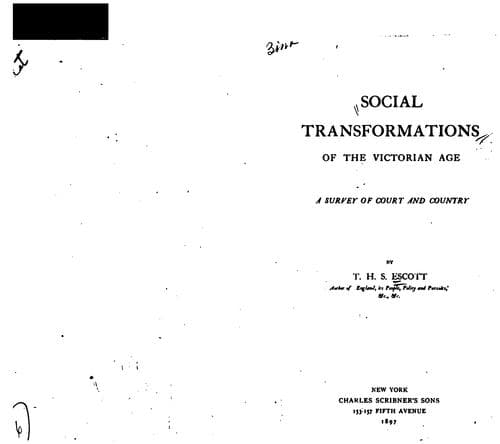
Social Transformations of the Victorian Age: A Survey of Court and CountryEscott, T. H. S. (Thomas Hay Sweet)
History
Social Transformations of the Victorian Age: A Survey of Court and Country
Escott, T. H. S. (Thomas Hay Sweet)
Great Britain -- Civilization -- 19th century; Great Britain -- Social life and customs -- 19th century
A verger at St Mary's Church, Oxford, during the sixties used devoutly to
thank his Maker that after having heard University sermons for thirty
years, he still remained a Christian. Conflicts within, attacks without,
at least as severe as any to which either was exposed during the Georgian
epoch, have been the lot of the Christianity whose depository is the
Church of England during the Victorian age. Neither Christian faith, nor
the Church that is its national expression, has come forth maimed or
weakened from that ordeal. Modern scepticism scarcely aims at substituting
for a Divine Being any tangible object of faith. It retires from the
discussion with the remark that high and invisible things are beyond human
knowledge. Hence nothing in agnosticism, however hostile its tendency to,
need be inconsistent with, Revelation. The mere statement of difficulties
in the way of belief and of purely abstract alternatives to belief makes
no proselytes.[107]
Freethinkers of the last century appealed, and were limited, to the rich.
The secularists who are their successors since 1840 pose as the friends of
the poor. Neither school can consider itself a power. The Victorian age is
in fact above all others an age of religious revival. This has been
largely due to the influence of the Court. From the _entourage_ of the
later Georges and of William IV. the best of their subjects held aloof.
Had the year of Revolution come then instead of in 1848, the English
throne, whose possessor lacked all personal hold of the people, might have
shared the fate of continental crowns.
The Queen saw nothing of any Court until she presided over a transformed
Court of her own. Her subjects no sooner knew their fresh ruler than they
were powerfully impressed by the contrast of her blameless life and
society to anything of which they had read, heard, or seen. Under such a
sovereign, a change in the whole spirit of the nation's religious life
naturally followed. Thinking minds had indeed long been in a state of
spiritual ferment. The Tractarian movement had begun with Keble's Assize
Sermon five years before the Queen's accession. Its full results were not
to be seen till 1846.
Meanwhile, in the third year of the reign the idea of reviving
Convocation, which since 1717 had been suspended, of which Burke had said
that it was without functions save to pay compliments to the king and then
dissolve, took form; since 1850, that body has met. Unreformed this
clerical parliament still remains. As in 1864 it declared _Essays and
Reviews_ heretical, but could not punish the men whom it branded, so,
to-day, a canon of Convocation, though approved by the Crown, has no
binding power. But the days when the _Times_, long since convinced of its
Erastian errors, could sneer at Convocation as 'a clerical debating
society with a long name' are altogether gone by.
Public-domain text, read in full here on John Shaqi.
Reviews
Reviews
No reviews yet
Be the first to share your thoughts on this work.
Elsewhere in the archive
Join the Discussion
Join the discussion
Sign in to leave a comment or review.
Sign InorCreate an account