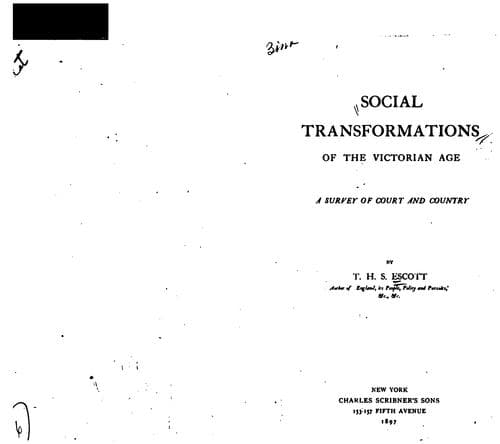
Social Transformations of the Victorian Age: A Survey of Court and CountryEscott, T. H. S. (Thomas Hay Sweet)
History
Social Transformations of the Victorian Age: A Survey of Court and Country
Escott, T. H. S. (Thomas Hay Sweet)
Great Britain -- Civilization -- 19th century; Great Britain -- Social life and customs -- 19th century
Many who are by no means ardent Churchmen, or are outside the Church
Communion, are interested to know the actual opinion of Convocation on
social and industrial questions of the hour, as this opinion is expressed
by educated men who reflect the views of their cloth at least as
faithfully as the House of Commons reflects the views of the people. Thus,
during the recent sittings of a single year, Convocation in its two
provinces with their divisions into lower and upper Houses, has discussed
and suggested solutions of subjects so varied as sisterhoods and
deaconesses, betting and gambling, popular education, soldiers' marriages,
marriage law amendment Bills, spiritual provision for workhouses, clergy
discipline Bill, the relations between the Church and State in the
Colonies. Even in its unreformed condition, this body can scarcely fail to
be of some use in officially telling Parliament men the opinion of the
Church, which, on any view of it, is at least a considerable corporation,
on matters affecting clerical interests or popular morals. In the remote
event of the Church being disestablished, Convocation is a useful drilling
ground on which Churchmen of all degrees can be trained to collective
action.
What are the facts relating to the Church to-day? At the opening of this
age, the beneficed clergy were often unfit for their posts; they were very
largely indifferent to their duties. The attacks on the Establishment led
by the Lord Henley of that day and others, shortly after the 1832 Reform
Act, were more organized and plausible than anything which has been
witnessed since. There are, after all, not many things more national in
England than the Church. Even the differences of the clergy, and the
professed desire of some among them to be free from State supervision,
have not lessened the national regard for the Established Faith. The
attack from within, therefore, seems likely to be weathered not less
successfully than the attack from without.
The parochial system of the Church--its clergy resident in every village
where the squire is often an absentee, has struck its fibres too deep into
the soil of English life, to be rooted out by any sectarian agitation. The
best proof that Church endowments do not check, but rather encourage,
private beneficence is the amount of money donations to the Established
Church during the present age. Gifts to the Church, whether in the shape
of lands, tithes, other rent charges, stock or cash, represent roughly a
sum of £5,500,000, yielding a perpetual yearly income of £181,940.
Public-domain text, read in full here on John Shaqi.
Reviews
Reviews
No reviews yet
Be the first to share your thoughts on this work.
Elsewhere in the archive
Join the Discussion
Join the discussion
Sign in to leave a comment or review.
Sign InorCreate an account