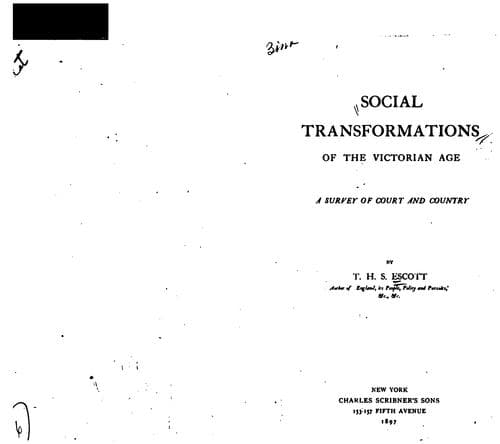
Social Transformations of the Victorian Age: A Survey of Court and CountryEscott, T. H. S. (Thomas Hay Sweet)
History
Social Transformations of the Victorian Age: A Survey of Court and Country
Escott, T. H. S. (Thomas Hay Sweet)
Great Britain -- Civilization -- 19th century; Great Britain -- Social life and customs -- 19th century
The second of the two Acts establishing the Ecclesiastical Commission is
of Victorian date. The operations of this body have increased the incomes
of Church livings by £1,016,775 a year, or by a capital sum of
£30,599,100; and this during the twelve years ending 1896-97. Queen Anne's
bounty does not, indeed, seem to have been uniformly administered with
such wisdom. Its funds have sometimes been granted to incumbents to
enlarge houses, schools, and other buildings beyond the point at which
there was an assured income for the maintenance of these fabrics. The
Tithes Commutation Act is not blamed for the periodical return of hard
times for the clergy. The distress itself is partial, sometimes
exaggerated. Still, there seems to have been a general reduction of
incomes in rural districts by 25 per cent. No offertories, which in towns
greatly help the clergy, can make the country deficiency good. The
suggestion of repealing the Act which put down pluralities so as to
concentrate several poor preferments in one incumbent is not likely to be
acted on. But some relaxation of the Act might be a feasible concession to
a growing opinion. Rich livings are sometimes the worst served. Some
re-adjustment of stipends after a new enquiry seems, therefore, likely to
be proposed.
So much for the purely English aspect of clerical activity in our age. The
alliance in the foreign enterprise of the Church with the State coincides
exclusively with the Victorian reign. In 1841 the Colonial Bishopric fund
was begun. By 1851 the Colonial episcopate was fairly organized. Four
years after the Queen's accession there were 10 Anglican dioceses out of
England. Sixty years after that accession there are 92.[108] These sees
are grouped into provincial Synods. This foreign Church, one in doctrine
with the Established Church at home, is modified in its agency and
development to suit the soil to which it is transplanted. The late Sir J.
R. Seeley, with respect to its calming influences amid jarring faiths, has
in a familiar passage dwelt on the Christianity of the English Church as a
reconciling element between the rival creeds of the Eastern world. Add to
this the organization of episcopal Protestantism of the Anglican type, not
only in the West Indies and in our Canadian Dominion, but in the United
States themselves.[109]
Public-domain text, read in full here on John Shaqi.
Reviews
Reviews
No reviews yet
Be the first to share your thoughts on this work.
Elsewhere in the archive
Join the Discussion
Join the discussion
Sign in to leave a comment or review.
Sign InorCreate an account