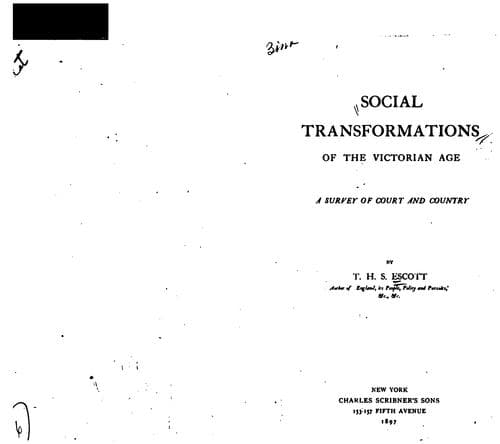
Social Transformations of the Victorian Age: A Survey of Court and CountryEscott, T. H. S. (Thomas Hay Sweet)
History
Social Transformations of the Victorian Age: A Survey of Court and Country
Escott, T. H. S. (Thomas Hay Sweet)
Great Britain -- Civilization -- 19th century; Great Britain -- Social life and customs -- 19th century
A fair idea may thus be formed of the State Church in its character of a
veritable catholic, not less than a national, power. Improved organization
does not always argue increased efficiency. The machinery of the Roman
Empire was never more elaborate than when it was in a state of atrophy.
Coinciding, however, with the unmistakable signs of spiritual life at home
and abroad, the domestic resources and the foreign work of the national
religion are tributes alike to the efficacy of the Church as a world-wide
instrument of righteousness, and to the increased motive power of religion
during the Victorian age. With the spiritual work that has been done,
certain names very briefly must be associated. The Oxford Tractarianism
between 1832-46 is only one of many manifestations of religious life which
mark that epoch, and which nearly perplexed into infidelity the Oxford
verger aforesaid. In extreme Evangelicalism outside our Church, the
followers of Wesley, regardless of their founder's injunction not to form
a separate sect, were perfecting their system when the reign began. In
1833, an English clergyman at Plymouth, J. L. Darby, left the National
Church and founded the sect of 'Brethren' who take their name from the
Western seaport where he had officiated. Fifteen years later, in 1848,
Plymouth Brethrenism was itself divided by one of Darby's followers, named
Newton; he created a clique of his own now called by their rival
religionists, the loose, or open, Brethren. The missionary and literary
activities of this little sect are really remarkable. In 1843
Presbyterianism across the Tweed had a schism of its own. The secession of
Chalmers on the issue of State patronage resulted in the founding of the
Free Kirk. The religious activity of the epoch has been universal. Among
the older dissenting bodies, Congregationalists, in point of numbers,
influence, in national repute of their leaders, perhaps come first. These
in 1837, numbered 170,000 full members. Now they number nearly 400,000. Of
the Baptists there were, in 1837, 125,000. Sixty years later they are
340,000. This increase is due to the single agency of C. H. Spurgeon,
whose personal influence is not yet fully realized but may be judged from
the circulation by millions of his posthumous Sermons, as well as by the
pulpit imitations of him in all Communions, not excepting the high
Anglican pulpits. Hence of course Nonconformist numbers depending largely
on individual attractions, are subject to greater fluctuations than in the
Establishment. Roman Catholics have increased in the large towns of
England and in the Colonies. In 1837 their priests were less than 1,000.
Fifty years later they were in round numbers 2,500. Their Churches have
risen from 600 to 1,350. The activity of British Evangelicalism is farther
shown by the doubling of the income of the British and Foreign Bible
Society during the reign, by the cost of a New Testament being ten-pence
in 1837, a penny in 1897.
Public-domain text, read in full here on John Shaqi.
Reviews
Reviews
No reviews yet
Be the first to share your thoughts on this work.
Elsewhere in the archive
Join the Discussion
Join the discussion
Sign in to leave a comment or review.
Sign InorCreate an account