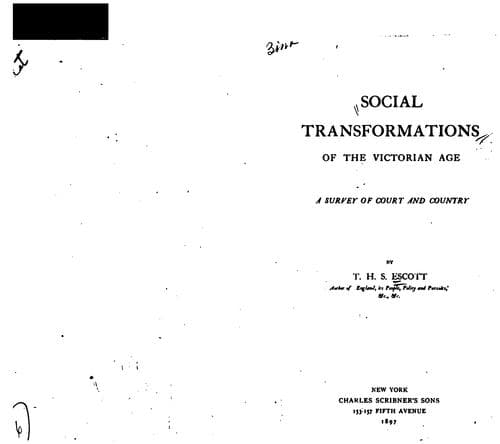
Social Transformations of the Victorian Age: A Survey of Court and CountryEscott, T. H. S. (Thomas Hay Sweet)
History
Social Transformations of the Victorian Age: A Survey of Court and Country
Escott, T. H. S. (Thomas Hay Sweet)
Great Britain -- Civilization -- 19th century; Great Britain -- Social life and customs -- 19th century
Similarly the income of the Propagation of the
Gospel Society is very nearly twice, and of the Church Missionary Society
almost thrice, as much to-day as it was in the Accession year.
Among Nonconformist bodies, numbers vary according to the eminence of
individual leaders, rising by bounds with a Spurgeon, diminishing
temporarily with some of his successors. Similarly, among Anglican
Communicants numbers fluctuate according to the influence of the leaders
of the great schools, a Liddon, or a Ryle, a Maurice, a Webb Peploe, or a
Lefroy. R. W. Dale, of Birmingham, whose work on the Atonement is a
recognised text book, even among many Anglicans, did as much as A. P.
Stanley of Westminster, to soften down sectarian differences, and to
command the respect of other Communions. Nor has Dale had any lack of
worthy successors now living. Unless religion had been ineradicable in the
national, because in the human, mind, results very different from this
general increase in the number of all religious Communions, judged by
whatever test, would have been witnessed.
Scarcely had the Church recovered from the shock of Newman's secession,
and the agitating effects during two decades of High Church and Low Church
controversies[110] when Dr Mansel, then an Oxford tutor and
professor,[111] in his ardent, but not wholly discreet zeal, expressed
views on the relations of the Infinite to the finite which, as F. D.
Maurice perceived, declaring the Deity to be unknowable by man, might be
perverted into an apology for agnosticism. That religion did not really
suffer is due in some degree to Benjamin Jowett. This good and honest
scholar's life was spent in educating young men into useful Christians,
into serious citizens, and into sincere believers. He claimed liberty; he
loved truth. He ridiculed with quiet satire the religious nescience and
despair which Mansel's terrific propaganda had been distorted into making
the vogue. When Dr Temple was made Primate:--the first and greatest
tribute was paid to the variety of Oxford ecclesiasticism that would be
rightly described not as the broad, or high, but as the hard Church.
There could be no more striking instance of the transformation in
religious ideas witnessed during our age than the fact that the volume to
which Dr Temple and Mr Jowett both contributed, _Essays and Reviews_, was
branded by Convocation as heretical during the sixties, and is discovered
to be harmless during the nineties.
Public-domain text, read in full here on John Shaqi.
Reviews
Reviews
No reviews yet
Be the first to share your thoughts on this work.
Elsewhere in the archive
Join the Discussion
Join the discussion
Sign in to leave a comment or review.
Sign InorCreate an account