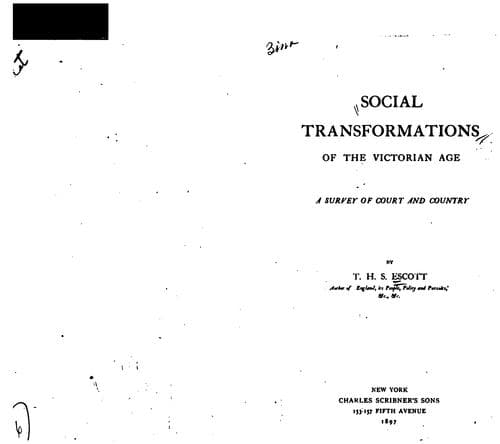
Social Transformations of the Victorian Age: A Survey of Court and CountryEscott, T. H. S. (Thomas Hay Sweet)
History
Social Transformations of the Victorian Age: A Survey of Court and Country
Escott, T. H. S. (Thomas Hay Sweet)
Great Britain -- Civilization -- 19th century; Great Britain -- Social life and customs -- 19th century
So qualified a judge on these matters as Mr Stopford Brooke deplores the
declension of religious liberalism into something indistinguishable from
unbelief. But as Professor Mansel's orthodox zeal for the dignity of his
faith helped his enemies rather than his friends, so the services rendered
by his devout successors are not always unmixedly conducive to the old
faith. The 'higher criticism' has been a dubious ally of Biblical
Christianity. _Lux Mundi_ distinguished between the historic and mythic
elements in the _Pentateuch_. The gifted editor of that work has more
recently[112] applied the same method to the sayings of the Founder of
Christianity, and has seemed to some to sanction the evaporation into
proverbs of some Divine utterances.[113]
CHAPTER XXX
THE QUEEN'S SUBJECTS AT PLAY--ACTIVE OR SEDENTARY
The new Court as head of the old society. Social transformations which
would most strike one revisiting the London West End in 1897. Going to
Court. Multiplication of clubs in St James's and Pall Mall, but
disappearance of gambling clubs. Socially transforming effects of the
Parliamentary Committee in 1844. Then and now. 'Play and Pay' betting
modified by its recommendations. Necessary connection between horse
breeding and horse racing. Cricket--then and now. The new football or
the old prize ring. Indoor amusements. Transformation, by development,
of Victorian chess. The men and events which have made it what it is.
Ladies' drawing room work. Middle class English ladies the great
readers nowadays. Fashionable needlework of all kinds from 1837-97.
The transformed society of the Victorian age may be regarded as a new
combination of old elements. The interests, and the pursuits represented
in it have always existed. The grouping and the mutual relations are the
only novelty. Even during the Prince Consort's time, the Court had begun
to be the federal head of the many coloured corporation which, under the
name of society, has superseded the 'genteel' or 'polite' world of earlier
days. That all liberal professions or worthy pursuits should find their
natural head among the representatives of the Crown was the central idea
of the Queen's husband. So far as the opportunities of a short life
allowed, he translated this notion into practice. It was reserved for his
eldest son to witness, and himself largely to promote, the full
realization of Prince Albert's purpose. The result is that to-day not only
diplomacy or soldiership, statemanship or wealth, sends its envoys to a
transformed Court. There is no sort of human achievement or distinction
that, directly it has won the approval of the people, lacks the
recognition, personal or vicarious, of the people's rulers.
Public-domain text, read in full here on John Shaqi.
Reviews
Reviews
No reviews yet
Be the first to share your thoughts on this work.
Elsewhere in the archive
Join the Discussion
Join the discussion
Sign in to leave a comment or review.
Sign InorCreate an account