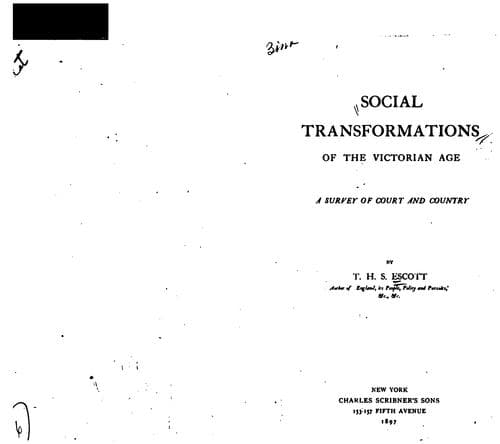
Social Transformations of the Victorian Age: A Survey of Court and CountryEscott, T. H. S. (Thomas Hay Sweet)
History
Social Transformations of the Victorian Age: A Survey of Court and Country
Escott, T. H. S. (Thomas Hay Sweet)
Great Britain -- Civilization -- 19th century; Great Britain -- Social life and customs -- 19th century
Each of the callings noticed in the present survey, clerical or lay, sends
its deputies to Marlborough House or Sandringham in the same way that
diplomacy and arms are represented at a Royal drawing room or levée. For a
reflection of the chief currents of thought, of the favourite pursuits of
the most absorbing interests and influences of Victorian England, the
historian will have to consult the list of visitors to the Heir Apparent's
house, or read the account of his doings. The Prince Consort was attacked
by the Tories in 1846 because he listened to Peel's speeches on Free Trade
from the Peers' Gallery in the Commons. In 1897 the Prince of Wales
attends daily the State trial of South African celebrities at Westminster,
and is praised for a fresh proof of his interest in Colonial affairs. No
artist or author; no sailor, soldier, cricketer or actor, makes his mark
upon his age without some tribute from a popular Court to prowess that is
already a household word with the multitude.
Thus in its relations to those aspects of national life in which the
people itself is most interested, the Court of to-day has been transformed
into a federal head of the entire motley system. If the competition of
individuals for personal recognition in the highest quarter sometimes
embitters social life, that is not the Royal patron's fault.
Among the changes which would make the fashionable quarter of the town
most difficult of recognition to-day by one who knew it only in the early
years of the reign, is the multiplication of joint stock palaces called
clubs, which are really co-operative homes for poor gentlemen.[114] The
absence of the gaming houses of which Crockford's was only one among many;
and the widely representative quality of the ladies and gentlemen whom our
stranger might notice driving to Court on a presentation day during the
season is as visible as the disappearance of the West End hells.[115]
In the seventh year after the Queen's accession, the House of Commons'
Committee on Gambling began its sittings. It was presided over by Lord
Palmerston. Among the witnesses it examined were men well known in every
section of London or of national life. Trainers, jockeys, magistrates,
policemen, all contributed to the remarkable picture of contemporary life
and manners, contained between the covers of this document.
Public-domain text, read in full here on John Shaqi.
Reviews
Reviews
No reviews yet
Be the first to share your thoughts on this work.
Elsewhere in the archive
Join the Discussion
Join the discussion
Sign in to leave a comment or review.
Sign InorCreate an account