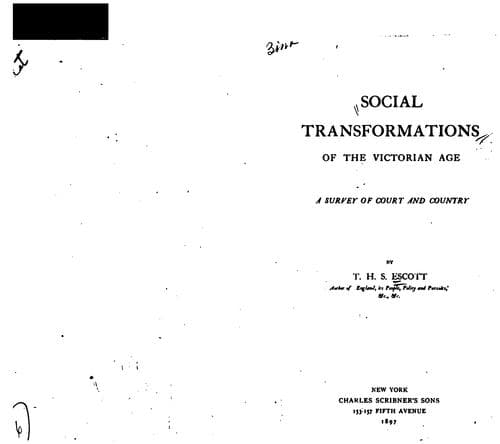
Social Transformations of the Victorian Age: A Survey of Court and CountryEscott, T. H. S. (Thomas Hay Sweet)
History
Social Transformations of the Victorian Age: A Survey of Court and Country
Escott, T. H. S. (Thomas Hay Sweet)
Great Britain -- Civilization -- 19th century; Great Britain -- Social life and customs -- 19th century
Transformation in our Colonial system shown by the latest facts and
figures. Special usefulness as well as Imperial value of the Colonies
to England. Social fusion of the mother country and the Colonies
prefigured by the presence and influence on both sides of the Atlantic
of the American element in the best society in London. Individual
influences which have promoted this movement, and are doing the same
thing for our Colonial cousins, as for our American.
No architectural change during the age has more affected the perspective
of Fleet Street and the Strand than the disappearance of Temple Bar and
its replacement by the griffin which marks its former site, and the
erection of the Royal Courts of Justice that now flank the central
thoroughfare. This is the outward and visible sign of a transformation not
less great, as regards the administration of the law within the new palace
of justice itself.
The Reform Act of 1832 was followed by various movements in Parliament in
the direction of law reform. The proposals and their very slight results
were solely technical; the public reaped no appreciable benefit so long as
the separation of the Common Law Courts from the Court of Chancery
existed, and on different sides of Westminster Hall two legal systems,
often mutually antagonistic, were at work. Ten years after the Accession,
the monopoly of Serjeants of Law in the old Court of Common Pleas was
swept away. Still justice was delayed. During the early days of railway
enterprise, commerce was obstructed, by the postponement, for inadequate
or vexatious reasons, of the trial of cases arising out of bills of
exchange on which large sums of money depended, and which, till they were
decided, blocked commercial enterprise. This may be looked back to now as
the scholastic era in nineteenth century law administration. The
categories into which causes and kinds of legal action and pleas, were
divided, in their pedantic complexity, recalled the tortuous refinements
of the logical school men upon the comparatively simple predicaments of
Aristotle.
Public-domain text, read in full here on John Shaqi.
Reviews
Reviews
No reviews yet
Be the first to share your thoughts on this work.
Elsewhere in the archive
Join the Discussion
Join the discussion
Sign in to leave a comment or review.
Sign InorCreate an account