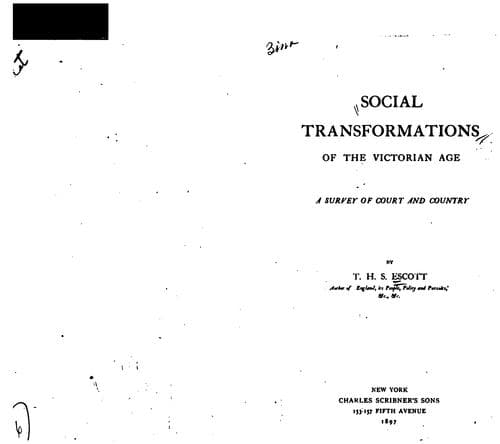
Social Transformations of the Victorian Age: A Survey of Court and CountryEscott, T. H. S. (Thomas Hay Sweet)
History
Social Transformations of the Victorian Age: A Survey of Court and Country
Escott, T. H. S. (Thomas Hay Sweet)
Great Britain -- Civilization -- 19th century; Great Britain -- Social life and customs -- 19th century
The pride that the Queen's subjects take in the Empire beyond seas,
created by Anglo-Saxon enterprise, and the honour they derive from it are
accompanied by the growing interest with which the Colonies are regarded
by political thinkers who see in their development an anticipation of the
constitutional movements soon to be witnessed on British soil. The
Australian legislatures have not only kept pace with, they have stolen a
march on, the socialistic Radicals of the old country. New Zealand
generally has led the way. This and three other Colonies, New South Wales,
Victoria and Tasmania, have adopted Woman's Suffrage with the legislative
freaks which seem to be its sequel. To the action of this franchise is
attributed the proposal recently made in one of these Parliaments to give
every domestic servant a statutory holiday once a week. Tasmania, too,
will not apparently be satisfied till she has secured the Swiss Referendum
for ending disputes between the two legislative Chambers by submitting the
single point in issue to the constituencies. Tasmania, also, has made
several efforts, as yet unsuccessfully, to acclimatise the Hare system of
proportional representation which is now forgotten in England, save when
some theorist uses a periodical re-adjustment of our franchise, to revive
its interest. South Australia, Victoria, and New South Wales, have also
attempted, but not as yet carried, the establishment of national banks;
perilous experiments enough for any new, or for that matter old, country.
Individual effort gave England its Colonies. The same agency--as embodied
in a Gibbon Wakefield, who began life by being Secretary to Lord Durham in
Canada 1838, who, 1839, obtained the annexation and colonization of New
Zealand, and who in 1849 published _The Art of Colonization_; in a Sir
William Molesworth, the pioneer of Colonial self-government; who,
obtaining from Palmerston the great object of his ambition, the Colonial
Secretaryship 1853, died shortly afterwards; more recently in the fourth
Lord Carnarvon, Colonial Secretary (1866-7; 1874-8)--applied the social
cement which has joined the new countries with the old in personal rather
than in merely political relation. Colonial patriotism was also reasonably
gratified on its intellectual side by Mr Lowe's sojourn in New South
Wales 1843-50, and by Sir Robert G. W. Herbert's share in the
Administration of Queensland before he became Colonial Under Secretary in
London.
Public-domain text, read in full here on John Shaqi.
Reviews
Reviews
No reviews yet
Be the first to share your thoughts on this work.
Elsewhere in the archive
Join the Discussion
Join the discussion
Sign in to leave a comment or review.
Sign InorCreate an account