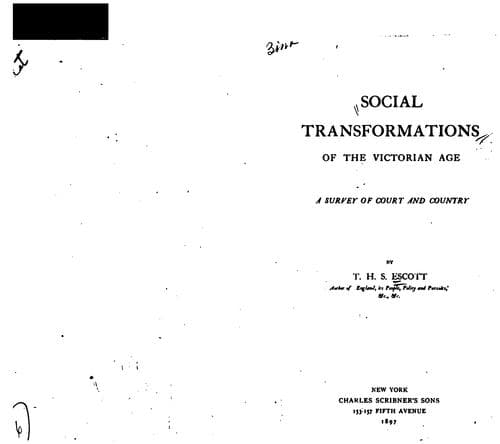
Social Transformations of the Victorian Age: A Survey of Court and CountryEscott, T. H. S. (Thomas Hay Sweet)
History
Social Transformations of the Victorian Age: A Survey of Court and Country
Escott, T. H. S. (Thomas Hay Sweet)
Great Britain -- Civilization -- 19th century; Great Britain -- Social life and customs -- 19th century
A shrewd Colonial statesman not long since observed that if another flying
Australian, but a born and bred Colonial horse, were to win the Derby, no
whisper of separation from the British Crown would ever be heard among the
most advanced of Colonial democrats. Popular enthusiasm at the Antipodean
winner of the Blue Ribbon would spread from Epsom Downs throughout the
kingdom; it would be flashed along every wire or transmitted by every
cable to the four winds of heaven; the Colonists would cease to complain
that they, or their products, were not appreciated by the mother country.
This half serious remark contains more than a grain of truth; it points to
the fact that the grievance alleged by our kinsman beyond sea against the
headquarters of their race is sentimental, rather than practical. Pending
the Derby winner from beyond seas, the less sternly democratic of
England's Colonial cousins have appreciated the peerages bestowed on a few
of them, and can point to other substantial proofs that they have become a
power in English society. Thus they have founded clubs in London; they
possess a party of their own in the House of Commons, and entertain the
social leaders of the old country at their balls and parties during the
season in famous restaurants, or at their own homes.
Till the Victorian age was well developed, the latter day American
elements in London fashion were unheard of. To-day these leaven the whole
of our social life. It is those born under the Stripes and Stars who
relieve, at a princely rental, English nobles of house property which its
owners are not occupying, and supply Countesses and Duchesses to the
English peerage. The great feature of our time has been the concentration
of our people in the Metropolis. A like gravitation to towns has indeed
taken place throughout the whole country. Between the eighties and the
nineties, the increase of the urban population has been 3,016,579; the
decrease of the rural has been 139,545.[120]
Public-domain text, read in full here on John Shaqi.
Reviews
Reviews
No reviews yet
Be the first to share your thoughts on this work.
Elsewhere in the archive
Join the Discussion
Join the discussion
Sign in to leave a comment or review.
Sign InorCreate an account