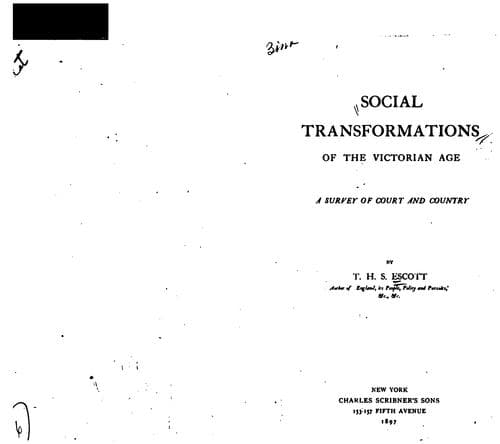
Social Transformations of the Victorian Age: A Survey of Court and CountryEscott, T. H. S. (Thomas Hay Sweet)
History
Social Transformations of the Victorian Age: A Survey of Court and Country
Escott, T. H. S. (Thomas Hay Sweet)
Great Britain -- Civilization -- 19th century; Great Britain -- Social life and customs -- 19th century
With respect to this movement, as in other matters, London has shown
itself the true mirror of England. For a proof of this, it would be enough
to mention the Langham Hotel, and those caravanserais which have followed
it, down to the latest and most palatial of all, the Hotel Cecil. That the
capital thus socially re-created has been successfully reorganized as the
most cosmopolitan and modish centre of fashion for two hemispheres is due
largely to the agency of American dollars and American arbiters of
elegance. In the thirties and the sixties the gifted men who were sent to
represent the United States in the old country, a Washington Irving, and a
Lothrop Motley, made their Embassies social centres for the most pleasant
company of the time, attracted famous men from their own country, one of
whom, the Rev. Cleveland Coxe,[121] formed a lasting link between the two
chief branches of the Anglo-Saxon Church, most of these Transatlantic
visitors left behind them brilliant reputations as conversationalists.
More recently a Russell Lowell and a Bayard have adorned this tradition.
In their day, the American season following hard upon the London season
proper has become a regular, and to all concerned most profitable,
observance in the social calendar. The dictatresses of polite life from
the other side of the Atlantic generally have been educated in Paris, not
a few of them by the daughter of Emile Souvestre at that institution for
turning intelligent girls into charming women, Les Ruches, Fontainebleau;
they always bring with them to their London homes the tastes of citizens
of the world. These tastes are gratified as successfully on the Thames as
on the Seine; it is _la belle Americaine_ who has most visibly impressed
her image on the capital where, since the Second Empire fell, she has
chiefly delighted to dwell; she decided that English life needed
enlivening: she has enlivened it and continues to do so effectually. Some
restlessness is constitutional to her, as also to the Anglo-Indians and
Colonials who are perennially so much with us; thus largely to please her
the London season is now subdivided into innumerable parts. It would be
truer to say some form of that season lasts all the year round. The
constant locomotion from one centre, or from one country seat to another,
began, as has been already seen, with the Prince Consort. It has not been
discouraged by later representatives of the Crown. From the day that in
1860 the Prince of Wales visited the tomb of George Washington, he has
never lost the American heart. The new London régime exactly suits the
future peeresses of the old country when they are fresh from New York.
Public-domain text, read in full here on John Shaqi.
Reviews
Reviews
No reviews yet
Be the first to share your thoughts on this work.
Elsewhere in the archive
Join the Discussion
Join the discussion
Sign in to leave a comment or review.
Sign InorCreate an account