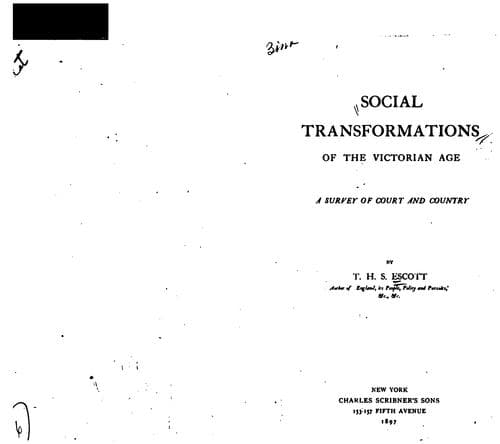
Social Transformations of the Victorian Age: A Survey of Court and CountryEscott, T. H. S. (Thomas Hay Sweet)
History
Social Transformations of the Victorian Age: A Survey of Court and Country
Escott, T. H. S. (Thomas Hay Sweet)
Great Britain -- Civilization -- 19th century; Great Britain -- Social life and customs -- 19th century
The constant alternations of Hyde Park promenades, not only with suburban
racecourses, but with long days under summer suns given to Thames-side
picnics, or with rapid flittings on any opportunity to and fro between
Mayfair on the one hand, the Boulevard des Italiens, Monte Carlo, or
Homburg on the other: these innovations have been brought about by the
American Londoner more than by any other single person. The Colonial
millionaire or millionairess has not yet been so fully developed as their
Transatlantic equivalents. But the process is going steadily forward, no
doubt with similar results to follow.
The contrast between the amount of international friction that was caused
before the Oregon Boundary dispute, and the Trent difference, between the
two countries were composed in 1846 and in 1863, respectively, and the
comparative ease with which the Venezuela Question in our own day was
settled, suggests the solid international advantages of the arrangement
under which New York and London have become socially one and the same
capital, having their pleasures, their lions and lionesses, their
favourite composers, authors, dramatists and players, in common.
The late Mr Samuel Ward, who is as well remembered in London as in New
York, and who liked to be called the prince of _bon vivants_ at
Delmonico's, the king of the lobby at Washington, was a cultivated little
old gentleman, of whom it is difficult to conceive as ever having been
much less, or more, than some seventy-odd years of age. He was known
throughout the whole Anglo-Saxon world as 'Uncle Sam.' He had become
popular in English society soon after the examples of the then Lord
Hartington and Lord Rosebery included America in the grand tour of every
educated Briton. He really did something to entitle him to his universal
sobriquet. He was the founder of a social and literary Anglo-American
school which has struck its roots deep in the chosen homes of English
fashion. As Californian gold preceded Australian, so the Transatlantic
force that has transformed the social England of our day has come before
the fully organized exercise of a Colonial power of the same sort. But
every year brings one visibly nearer its final development, with all the
international advantages which will no doubt accompany that event.[122]
INDEX
A
ADDRESSES of Prince Consort on Exhibition of 1851, 322.
AGNEW, Mr (now Sir William), sketch of, 51;
gives £10,100 for Gainsborough's Duchess of Devonshire, 52.
ALFRED Club, the 'Dandies' Club, 5;
named after Count Alfred D'Orsay, 5.
ALMACK'S, subscription balls at, at end of 18th century, 196;
modern suburban subscription balls, imitations of, 197.
AMERICAN elements in modern London Society, 435;
countesses and duchesses, 435;
embassies and ministers--Washington Irving and Motley, 435;
Russell Lowell and Bayard, 436;
ladies, their education in Paris, 436;
restlessness a characteristic feature of, 436.
Public-domain text, read in full here on John Shaqi.
Reviews
Reviews
No reviews yet
Be the first to share your thoughts on this work.
Elsewhere in the archive
Join the Discussion
Join the discussion
Sign in to leave a comment or review.
Sign InorCreate an account