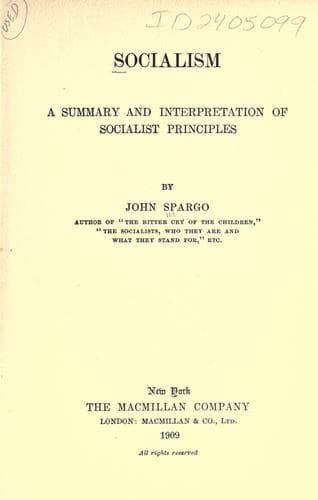
Socialism: A Summary and Interpretation of Socialist PrinciplesSpargo, John
History
Socialism: A Summary and Interpretation of Socialist Principles
Spargo, John
Socialism
The studious years spent in the reading room of the British Museum
complete the anglicization of Marx. "Capital" is essentially an English
work, the fact of its having been written in German, by a German writer,
being merely incidental. No more distinctively English treatise on
political economy was ever written, not even "The Wealth of Nations."
Even the method and style of the book are, contrary to general opinion,
much more distinctly English than German. I do not forget his Hegelian
dialectic with its un-English subtleties, but against that must be
placed the directness, vigor, and pointedness of style, and the cogent
reasoning, with its wealth of concrete illustrations, which are as
characteristically English. Marx belongs to the school of Petty, Smith,
and Ricardo, and their work is the background of his. "Capital" was the
child of English industrial conditions and English thought, born by
chance upon German soil.
Toward the middle of the nineteenth century, English economic thought
was entirely dominated by the ideas and methods of Ricardo, who has been
described by Senior, not without justice, as "the most incorrect writer
who ever attained philosophical eminence."[152] So far as such a
sweeping criticism can be justified by looseness in the use of terms, it
is justified by Ricardo's failing in this respect. That he should have
attained the eminence he did, dominating English economic thought for so
many years, in spite of the confusion which his loose and uncertain use
of words occasioned, is not less a tribute to Ricardo's genius than
evidence of the poverty of political economy in England at that time. In
view of the constant and tiresome reiteration of the charge that Marx
pillaged his labor-value theory from Thompson, Hodgskin, Bray, or some
other more or less obscure writer of the Ricardian school, it is well to
remember that there is nothing in the works of any of these writers
connected with the theory of value which is not to be found in the
earlier work of Ricardo himself. In like manner, the theory can be
traced back from Ricardo to the master he honored, Adam Smith.
Furthermore, almost a century before the appearance of "The Wealth of
Nations," Sir William Petty had anticipated the so-called Ricardian
labor-value theory of Smith and his followers.
Public-domain text, read in full here on John Shaqi.
Reviews
Reviews
No reviews yet
Be the first to share your thoughts on this work.
Elsewhere in the archive
Join the Discussion
Join the discussion
Sign in to leave a comment or review.
Sign InorCreate an account