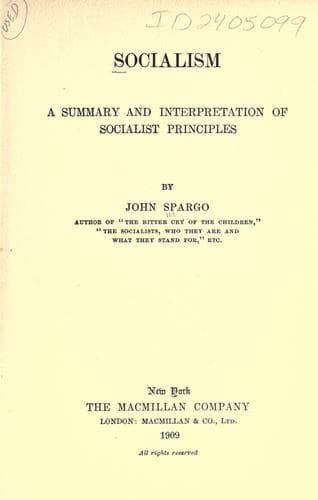
Socialism: A Summary and Interpretation of Socialist PrinciplesSpargo, John
History
Socialism: A Summary and Interpretation of Socialist Principles
Spargo, John
Socialism
Petty, rather than Smith, is entitled to be regarded as the founder of
the classical school of political economy, and Cossa justly calls him
"one of the most illustrious forerunners of the science of statistical
research."[153] He may indeed fairly be said to have been the father of
statistical science, and was the first to apply statistics, or
"political arithmetick," as he called it, to the elucidation of economic
theory. He boasts that "instead of using only comparative and
superlative Words, and intellectual Arguments," his method is to speak
"in Terms of Number, Weight, or Measure; to use only Arguments of Sense;
and to consider only such Causes, as have visible Foundations in Nature;
leaving those that depend upon the mutable Minds, Opinions, Appetites,
and Passions of particular Men, to the Consideration of others."[154]
The celebrated saying of this sagacious thinker that "labor is the
father and active principle of wealth; lands are the mother," is more
Marxian than Ricardian. Petty divided the population into two classes,
the productive and non-productive, and insisted that the value of all
things depends upon the labor it costs to produce them. This is, as we
shall see, entirely Ricardian, but not Marxian. But these are the ideas
Marx is supposed to have borrowed, without acknowledgment, from
comparatively obscure followers of Ricardo, in spite of the fact that he
gives abundant credit to the earlier writer. It has been asked with
ample justification whether these critics of Marx have read either the
works of Marx or his predecessors.
Adam Smith, who accepted the foregoing principles laid down by Petty,
followed his example of basing his conclusions largely upon observed
facts instead of abstractions. It is not the least of Smith's merits
that, despite his many digressions, looseness of phraseology, and other
admitted defects, his love for the concrete kept his feet upon the solid
ground of fact. With his successors, notably Ricardo and John Stuart
Mill, it was far otherwise. They made political economy an isolated
study of abstract doctrines. Instead of a study of the meaning and
relation of facts, it became a cult of abstractions, and the aim of its
teachers seemed to be to render the science as little scientific, and
as dull, as possible. They set up an abstraction, an "economic man," and
created for it a world of economic abstractions. It is impossible to
read either Ricardo or John Stuart Mill, but especially the latter,
without feeling the artificiality of the superstructures they created,
and the justice of Carlyle's description of such political economy as
the "dismal science." With a realism greater even than Adam Smith's, and
a more logical method than Ricardo or John Stuart Mill, Marx restored
the science of political economy to its old fact foundations.
IV
Public-domain text, read in full here on John Shaqi.
Reviews
Reviews
No reviews yet
Be the first to share your thoughts on this work.
Elsewhere in the archive
Join the Discussion
Join the discussion
Sign in to leave a comment or review.
Sign InorCreate an account