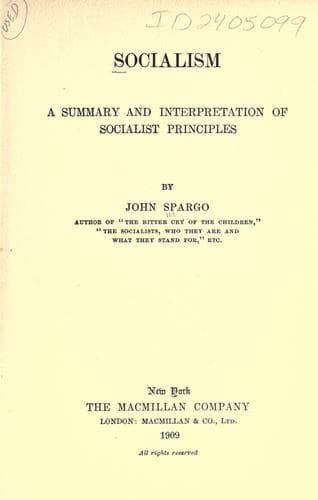
Socialism: A Summary and Interpretation of Socialist PrinciplesSpargo, John
History
Socialism: A Summary and Interpretation of Socialist Principles
Spargo, John
Socialism
The _geist_ of social and political evolution is economic, according to
the Socialist philosophy. This view of the importance of man's economic
relations involves some very radical changes in the methods and
terminology of political economy. The philosophical view of social and
political evolution as a world-process, through revolutions formed in
the matrices of economic conditions, at once limits and expands the
scope of political economy. It destroys on the one hand the idea of the
eternality of economic laws and limits them to particular epochs. On the
other hand, it enhances the importance of the science of political
economy as a study of the motive force of social evolution. With Marx
and his followers, political economy is more than an analysis of the
production and distribution of wealth; it is a study of the principal
determinant factor in the social and political progress of society,
consciously recognized as such.
The sociological viewpoint appears throughout the whole of Marxian
economic thought. It appears, for instance, in the definition of a
commodity as the unit of wealth _in those societies in which the
capitalist mode of production prevails_. Likewise wealth and capital
connote special social relations or categories. Wealth, which in certain
simpler forms of social organization consists in the ownership of
use-values, under the capitalist system consists in the ownership of
exchange-values. Capital is not a thing, but a social relation between
persons established through the medium of things. Robinson Crusoe's
spade, the Indian's bow and arrow, and all similar illustrations given
by the "orthodox" economists, do not constitute capital any more than an
infant's spoon is capital. They do not serve as the medium of the social
relation between wage-worker and capitalist which characterizes the
capitalist system of production. The essential feature of capitalist
society is the production of wealth in the commodity form; that is to
say, in the form of objects that, instead of being consumed by the
producer, are intended to be exchanged or sold at a profit. Capital,
therefore, is wealth set aside for the production of other wealth with a
view to its exchange at a profit. A house may consist of certain
definite quantities of bricks, timber, lime, iron, and other substances,
but similar quantities of these substances piled up without plan will
not constitute a house. Bricks, timber, lime, and iron become a house
only in certain circumstances, when they bear a given ordered relation
to each other. "A negro is a negro; it is only under certain conditions
that he becomes a slave. A certain machine, for example, is a machine
for spinning cotton; it is only under certain defined conditions that it
becomes capital. Apart from these conditions, it is no more capital than
gold _per se_ is money; capital is a social relation of
production."[163]
Public-domain text, read in full here on John Shaqi.
Reviews
Reviews
No reviews yet
Be the first to share your thoughts on this work.
Elsewhere in the archive
Join the Discussion
Join the discussion
Sign in to leave a comment or review.
Sign InorCreate an account