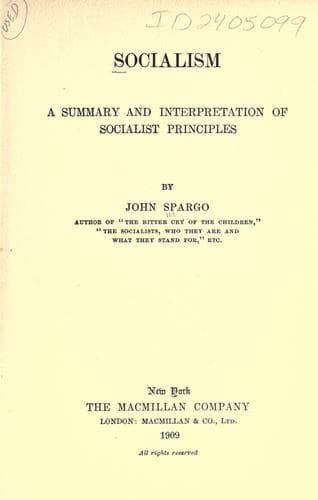
Socialism: A Summary and Interpretation of Socialist PrinciplesSpargo, John
History
Socialism: A Summary and Interpretation of Socialist Principles
Spargo, John
Socialism
The real law of value, then, according to Marx, is as follows: Under
capitalism, _in free competition_, the value of all commodities, other
than those unique things which cannot be reproduced by human labor, is
determined by the amount of _abstract_ labor embodied in them; or,
better, by the amount of social human labor power necessary, on the
average, for their production. We may conveniently illustrate this
theory by a concrete example. Let us, therefore, return to our
coat-makers. Now, always assuming their equal utility, no one will be
willing to pay twice as much for the coat produced by the slow worker
with poor tools as for the other. If the more economical methods of
production employed by the man who makes his coats in half the time
taken by the other man are the methods usually employed in the
manufacture of coats, and the time he takes represents the average time
taken to produce a coat, then the average value of coats will be
determined thereby, and coats produced by the slower, less economical
process will command only the same price in the market, the fact that
they may embody twice the amount of actual labor counting for nothing.
If we reverse the order of this proposition, and suppose the slower,
less economical methods to be those generally prevailing in the
manufacture of coats, and the quicker, more economical methods to be
exceptional, then, all other things being equal, the exchange-value, of
coats will be determined by the amount of labor commonly consumed, and
the fortunate producer who adopts the exceptional, economical methods
will, for a time, reap a golden harvest. Only for a time, however. As
the new methods prevail, competition being the impelling force, they
become less and less exceptional, and, finally, the regular, normal
methods of production and the standard of value.
It is this very important qualification, fundamental to the Marxian
theory, which is most often lost sight of by the critics. They persist
in applying to individual commodities the test of comparing the amounts
of labor-power actually consumed in their production, and so confound
the Marxian theory with its crude progenitors. In refuting this crude
theory, they are quite oblivious of the fact that Marx himself
accomplished that by no means difficult feat. To state the Marxian
theory accurately, we must qualify the bald statement that the
exchange-value of commodities is determined by the amount of labor
embodied in them, and state it in the following manner: _The
exchange-value of commodities is determined by the amount of average
labor at the time socially necessary for their production._ This is
determined, not absolutely in individual cases, but approximately in
general, by the bargaining and higgling of the market, to adopt Adam
Smith's well-known phrase.
Public-domain text, read in full here on John Shaqi.
Reviews
Reviews
No reviews yet
Be the first to share your thoughts on this work.
Elsewhere in the archive
Join the Discussion
Join the discussion
Sign in to leave a comment or review.
Sign InorCreate an account