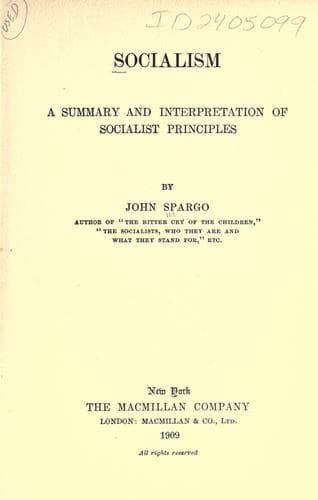
Socialism: A Summary and Interpretation of Socialist PrinciplesSpargo, John
History
Socialism: A Summary and Interpretation of Socialist Principles
Spargo, John
Socialism
Now, this theory applies to those things, exclusive of the category of
"unique values," which cannot be made by labor and are commonly supposed
to owe their value to their rarity. For example, we may take diamonds. A
man walking along the great wastes of the African _karoo_ comes across a
little stream. As he stoops to drink, he sees in the water a number of
glittering diamonds. To pick them out is the work of a few minutes only,
but the diamonds are worth many thousands of dollars. The law of value
above outlined applies just as much to them as to any other commodity.
The value of diamonds is determined by the amount of labor expenditure
necessary _on an average_ to procure them. If the normal method of
obtaining diamonds were simply to go to the nearest stream and pick them
out, their value would fall, possibly to zero:--
"When we have nothing else to wear
But cloth of gold and satins rare,
For cloth of gold we cease to care--
Up goes the price of shoddy."
IV
Most writers do not distinguish between price and value with sufficient
clearness, using the terms as if they were synonymous and
interchangeable. Where utilities are exchanged directly one for
another, as in the barter of primitive society, there is no need of a
price-form to express value. In highly developed societies, however,
where the very magnitude of production and exchange makes direct barter
impossible, and where the objects to be exchanged are not commonly the
product of individual labor, a medium of exchange becomes necessary; a
something which is generally recognized as a safe and stable commodity
which can be used to express in terms of its own weight, size, shape, or
color, the value of other commodities to be exchanged. This is the
function of money. In various times and places wheat, shells, skins of
animals, beads, powder, tobacco, and a multitude of other things, have
served as money, but for various reasons, more or less obvious, the
precious metals, gold and silver, have been most favored.
Public-domain text, read in full here on John Shaqi.
Reviews
Reviews
No reviews yet
Be the first to share your thoughts on this work.
Elsewhere in the archive
Join the Discussion
Join the discussion
Sign in to leave a comment or review.
Sign InorCreate an account