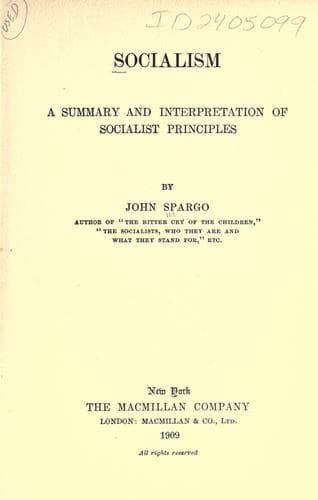
Socialism: A Summary and Interpretation of Socialist PrinciplesSpargo, John
History
Socialism: A Summary and Interpretation of Socialist Principles
Spargo, John
Socialism
In all commercial countries to-day, one or other of these metals, or
both of them, serves as the recognized medium of exchange. They are
commodities also, and when we say that the value of a commodity is a
certain amount of gold, we equally express the value of that amount of
gold in terms of the commodity in question. As commodities, the precious
metals are subject to the same laws as other commodities. If gold should
be discovered in such abundance that it became as plentiful and easy to
obtain as coal, its value would be no greater than that of coal. It
might, conceivably, still be used as the medium of exchange, but it
would--unless protected by legislation or otherwise from the operation
of economic law, and so given a monopoly-price--have an exchange-value
equal to that of coal, a ton of the one being equal to a ton of the
other--provided, of course, that its utility remained. Since the
scarcity of gold is an important element in its utility valuation,
creating and fostering the desire for its possession, that utility-value
might largely disappear if gold became as plentiful as coal, in which
case it would not have the same value as coal, and might cease to be a
commodity at all.
Price, then, is the expression of value in terms of some other
commodity, which, generally used for that purpose of expressing the
value of other commodities, we call money. It is only an approximation
of value, and subject to a much greater fluctuation than value itself.
It may, for a time, fall far below or rise above value, but in a free
market--the only condition in which the operation of the law may be
judged--sooner or later the equilibrium will be regained. Where monopoly
exists, the free market condition being non-existent, price may be
constantly elevated above value. Monopoly-price is an artificial
elevation of price above value, and must be considered separately as the
abrogation of the law of value.
Public-domain text, read in full here on John Shaqi.
Reviews
Reviews
No reviews yet
Be the first to share your thoughts on this work.
Elsewhere in the archive
Join the Discussion
Join the discussion
Sign in to leave a comment or review.
Sign InorCreate an account