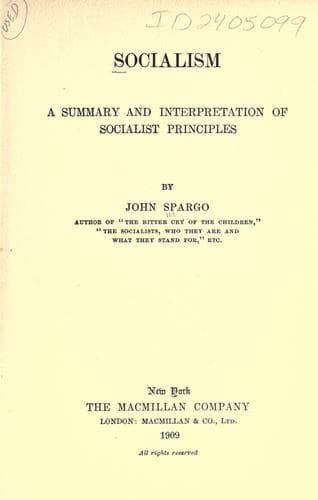
Socialism: A Summary and Interpretation of Socialist PrinciplesSpargo, John
History
Socialism: A Summary and Interpretation of Socialist Principles
Spargo, John
Socialism
Failure to discriminate between value and its price-expression, or
symbol, has led to endless difficulty. It lies at the bottom of the
naive theory that value depends upon the relation of supply and demand.
Lord Lauderdale's famous theory has found much support among later
economists, though it is now rather unpopular when stated in its old,
simple form. Disguised in the so-called Austrian theory of final
utility, it has attained considerable vogue.[172] The theory is
plausible and convincing to the ordinary mind. Every day we see
illustrations of its working: prices are depressed when there is an
oversupply, and elevated when the demand of would-be consumers exceeds
the supply of the commodities they desire to buy. It is not so easy to
see that these effects are temporary, and that there is an automatic
adjustment going on. Increased demand raises prices for a while, but it
also calls forth an increase in supply which tends to restore the old
price level, or may even force prices below it. In the latter case, the
supply falls off and prices find their real level. The relation of
supply to demand causes an oscillation of prices, but it is not the
determinant of value. When prices rise above a certain level, demand
slackens or ceases, and prices are inevitably lowered. Prices may and do
fall with a decreased demand, but it is clear that unless the producers
can get a price approximately equal to the value of their commodities,
they will cease to produce them, and the supply will diminish or cease
altogether. Ultimately, therefore, the fluctuations of price through the
lack of equilibrium between supply and demand adjust themselves, and
prices must tend constantly to approximate values.
Public-domain text, read in full here on John Shaqi.
Reviews
Reviews
No reviews yet
Be the first to share your thoughts on this work.
Elsewhere in the archive
Join the Discussion
Join the discussion
Sign in to leave a comment or review.
Sign InorCreate an account