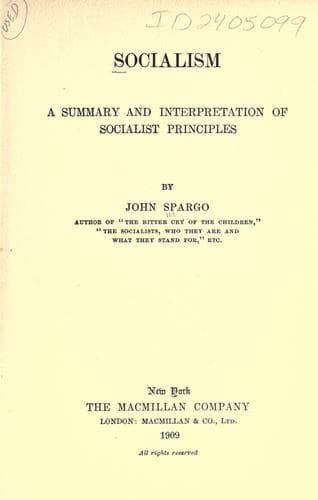
Socialism: A Summary and Interpretation of Socialist PrinciplesSpargo, John
History
Socialism: A Summary and Interpretation of Socialist Principles
Spargo, John
Socialism
Monopoly-price is, as already observed, an artificial price in the sense
that the laws of free market exchange do not apply to it. The "unique
utilities," things not reproducible by human labor, command what might
be termed natural monopoly-prices. There are many other commodities,
however, the price of which is not regulated by the quantity of social
human labor necessary to produce them, but simply by the desire of the
purchasers and the means they have of gratifying it and the power of the
sellers to control the market and exclude effective competition. Since
Karl Marx wrote, the exceptions to his law of value have become more
numerous, as a result of the changes in industrial and commercial
conditions. The development of great monopolies and near-monopolies has
greatly increased the number of commodities which, for considerable
periods, are placed outside the sphere of the labor-value theory, their
price depending upon their marginal utility, irrespective of the labor
actually embodied in them or necessary to their reproduction. It may, in
the opinion of the present writer, be said in criticism of the followers
of Marx that they have not carried on his work, but largely contented
themselves with repeating generalizations which, true when made, no
longer fit all the facts. But that is not a criticism of Marx, or of his
work. What he professed to make was an analysis of the methods of
production and exchange in competitive capitalist society. His followers
have largely failed to allow for the enormous changes which have taken
place, and go on repeating, unchanged, his phrases.
Public-domain text, read in full here on John Shaqi.
Reviews
Reviews
No reviews yet
Be the first to share your thoughts on this work.
Elsewhere in the archive
Join the Discussion
Join the discussion
Sign in to leave a comment or review.
Sign InorCreate an account