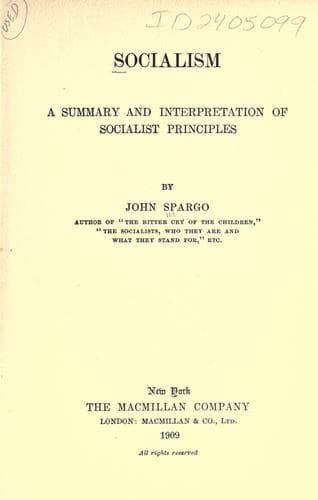
Socialism: A Summary and Interpretation of Socialist PrinciplesSpargo, John
History
Socialism: A Summary and Interpretation of Socialist Principles
Spargo, John
Socialism
Professor Seligman has pointed out that Ricardo's contention that value
is determined by the cost of production, and the contention of Jevons
that value is determined by marginal utility, are not mutually
exclusive, but, on the contrary, complementary to each other.[173] The
present writer has long contended that the marginal utility theory and
the Marxian labor-value theory are likewise not antagonistic but
complementary.[174] This is not the place to enter into the elaborate
discussion which this contention involves. Only a brief indication of
the argument for the claim is here and now possible. First, as we have
seen, Marx is very careful to insist that utility is essential to value,
and that the utility must be a social utility. But social utility does
not come of itself, from the skies or elsewhere. It is, so far as the
vast majority of commodities is concerned, the product of labor. It is
true that the value of a thing is never independent of its social
utility; it is likewise true that this is determined by the social labor
necessary to the reproduction of that utility. To regard the two
theories as antagonistic, it seems to be necessary to say either (1)
that the quantity of social labor necessary to produce certain
commodities determines their value, utterly regardless of the amount of
their social utility, or (2) that we estimate the social utility of
commodities, estimate what we are willing to pay for them, utterly
regardless of the labor necessary, on an average, for their
reproduction. The latter contention would be absurd, and the former
would involve the abandonment of the initial premises of the Marxian
theory, contained in his definition of a commodity. In so far as the
basis of social utility is the social labor necessary for its
production, the labor-value theory of Marx may be said, I think, to
include the marginal utility law, as one of the forms in which it
operates.
V
Public-domain text, read in full here on John Shaqi.
Reviews
Reviews
No reviews yet
Be the first to share your thoughts on this work.
Elsewhere in the archive
Join the Discussion
Join the discussion
Sign in to leave a comment or review.
Sign InorCreate an account