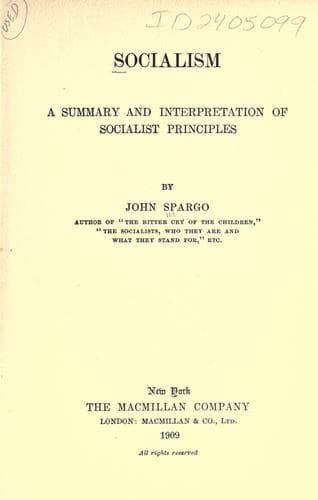
Socialism: A Summary and Interpretation of Socialist PrinciplesSpargo, John
History
Socialism: A Summary and Interpretation of Socialist Principles
Spargo, John
Socialism
Labor, the source and determinant of value, has, _per se_, no value.
Only when it is embodied in certain forms has it any value. If a man
labors hard digging holes and refilling them, his labor has no value.
What the capitalist buys is not labor, but labor-power. Wages in general
is a form of payment for a given amount of labor-power, measured by
duration and skill. The laborer sells brain and muscle power, which is
thus placed at the temporary disposal of the capitalist to be used up
like any other commodity that he buys. The philosopher Hobbes, in his
"Leviathan," clearly anticipated Marx in thus distinguishing between
labor and laboring power in the saying, "_The value or worth of a man is
... so much as would be given for the Use of his Power_." The power to
labor assumes the commodity form, being at once a use-value and an
exchange-value. At first sight it appears that piecework is an exception
to the general rule that the capitalist buys labor-power and not labor
itself. It seems that when piece-wages are paid it is not the machine,
the living labor-power, but the product of the machine, labor actually
performed, that is bought. Superficially, this is so, of course, but it
does not affect the principle laid down, because, as a matter of fact,
the piecework system is only one of the means used to secure a maximum
of labor-power. The average output of pieceworkers in a trade always
tends to become the standard output for the time-workers, and, on the
other hand, the average wage of pieceworkers tends to keep very near the
standard of time-wages.
Public-domain text, read in full here on John Shaqi.
Reviews
Reviews
No reviews yet
Be the first to share your thoughts on this work.
Elsewhere in the archive
Join the Discussion
Join the discussion
Sign in to leave a comment or review.
Sign InorCreate an account