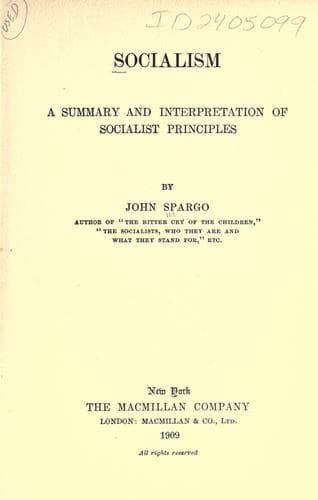
Socialism: A Summary and Interpretation of Socialist PrinciplesSpargo, John
History
Socialism: A Summary and Interpretation of Socialist Principles
Spargo, John
Socialism
What, it may be asked, will society do to prevent the hoarding of wealth
on the one hand, and the exploitation of the spendthrift by the
abstinent upon the other? Here, as throughout this discussion, we must
be careful to refrain from laying down dogmatic rules, giving
categorical replies to questions which the future will settle in its own
way. At best, we can only reason as to what possible answers are
compatible with the fundamental principles of Socialism. Thus we may
safely answer that in the Socialist regime society will not attempt to
dictate to the individual how he shall spend his income. If Jones
prefers _objets d'art_, and Smith prefers fast horses or a steam yacht,
each will be free to follow his inclinations so far as his resources
will permit. If, on the contrary, one should prefer to hoard his wealth,
he would be free to do so. The inheritance of such accumulated property,
other than personal objects, of course, might be denied, the state being
made the only possible inheritor of such accumulated property. Even in
the absence of such a regulation, the inheritance of hoarded wealth
would not be a serious matter and would speedily adjust itself. There
would be no opportunity for its _investment_, so that at most
individuals inheriting such property would be enabled to live idly, or
with extra luxury, until it was spent. The fact of inheriting property
would not give the individual power over the life and labor of others.
By either method, full play for individual liberty would be coupled with
full economic security for society. There would be no danger of the
development of a ruling class as a result of natural inequalities.
With such conditions as these, it is not difficult nor in any sense
romantic to suppose that the tendency to hoard wealth would largely
disappear. In the same way we must regard the possibilities of the
exploitation of man by man developing in the Socialist state, through
the wastefulness and improvidence of the one and the frugality,
abstinence, and cunning of the other, as slight. With the credit
functions entirely in the hands of the state, the improvident man would
be able to obtain credit upon the same securities as from a private
creditor, without extortion. Society would further secure itself against
the weakness and failure of the improvident by insuring all its members
against sickness, accident, and old age.
VIII
The administration of justice is necessarily a social function in a
democratic society. All juridical functions should be socialized in the
strict sense of being maintained at the social expense for the free
service of its citizens. Court fees, advocates' charges, and other
expenses incidental to the administration of justice in present society
are all anti-democratic and subversive of justice.
Public-domain text, read in full here on John Shaqi.
Reviews
Reviews
No reviews yet
Be the first to share your thoughts on this work.
Elsewhere in the archive
Join the Discussion
Join the discussion
Sign in to leave a comment or review.
Sign InorCreate an account