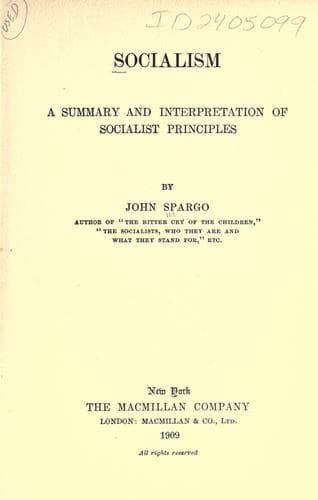
Socialism: A Summary and Interpretation of Socialist PrinciplesSpargo, John
History
Socialism: A Summary and Interpretation of Socialist Principles
Spargo, John
Socialism
Finally, education is likewise a social necessity which society itself
must assume responsibility for. We have discovered that for
self-protection society must insist upon a certain minimum of education
for every child able to receive it; that it is too vital a matter to be
left to the option of parents or the desires of the immature child. We
have made a certain minimum of education compulsory and free; the
Socialist state would make a minimum--probably much larger than our
present minimum--compulsory, but it would also make _all_ education
free. From the first stages, in the kindergartens, to the last, in the
universities, education must be wholly free or equality of opportunity
cannot be realized. So long as a single barrier exists to prevent any
child from receiving all the education it is capable of profiting by,
democracy is unattained.
Whether the Socialist state could tolerate the existence of elementary
schools other than its own, such as privately conducted kindergartens,
religious schools, and so on, is by no means agreed upon by Socialists.
It is like the question of marriage, a matter which is wholly beyond the
scope of present knowledge. The future will decide for itself. There are
those who believe that the state would not content itself with refusing
to permit religious doctrines or ideas to be taught in the schools, but
would go further, and, as the protector of the child, guard its
independence of thought in later life as far as possible by forbidding
religious teaching of any kind in schools for children below a certain
age. It would not, of course, attempt to prevent parental instruction in
religious beliefs in the home. Beyond the age prescribed, religious
education, in all other than public institutions of learning, would be
freely admitted. This restriction of religious education to the years of
judgment and discretion implies no hostility to religion on the part of
the state, but complete neutrality. Not the least important of the
rights of the child is the right to be protected from influences which
bias the mind and destroy the possibilities of independent thought in
later life, or make it attainable only as a result of bitter, needless,
tragic experience. This is one view. On the other hand, there are
probably quite as many Socialists who believe that the state would not
attempt to prevent the religious education of children of any age, in
schools voluntarily maintained for that purpose, independent of the
public schools. They believe that the state would content itself with
insisting that these religious schools must be so built and equipped as
not to imperil the lives or the health of the children attending them,
and so conducted as not to interfere with the public schools,--all of
which means simply that, like vaccination, and the form of marriage
contract, the question will be settled by the future in its own way.
There is nothing in the fundamental principles of Socialism, nor any
Public-domain text, read in full here on John Shaqi.
Reviews
Reviews
No reviews yet
Be the first to share your thoughts on this work.
Elsewhere in the archive
Join the Discussion
Join the discussion
Sign in to leave a comment or review.
Sign InorCreate an account