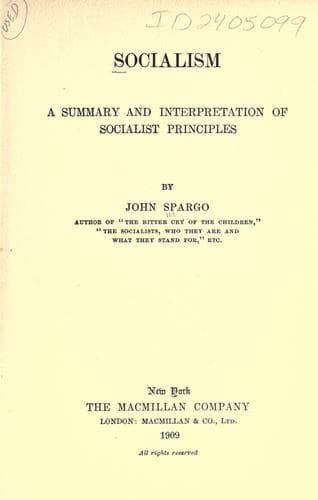
Socialism: A Summary and Interpretation of Socialist PrinciplesSpargo, John
History
Socialism: A Summary and Interpretation of Socialist Principles
Spargo, John
Socialism
body of facts in our present experience, from which we can judge the
manner of that settlement.
In this brief outline of the Socialist state as the writer, in common
with many of his associates, conceives it, there are many gaps. The
temptation to fill in the outline somewhat more in detail is strong, but
that is beyond the borderland which divides scientific and Utopian
methods. The purpose of the outline is mainly to show that the ideal of
the Socialism of to-day is something far removed from the network of
laws and the oppressive bureaucracy commonly imagined; something wholly
different in spirit and substance from the mechanical arrangement of
human relations imagined by Utopian romancers. If the Socialist
propaganda of to-day largely consists of the advocacy of laws for the
protection of labor and dealing with all kinds of evils, it must be
remembered that these are to _ameliorate conditions in the existing
social order_. Many of the laws for which Socialists have most
strenuously fought have their _raison d'etre_ in the conditions of
capitalist society, and would be quite unnecessary under Socialism. If a
reference to one's personal work may be pardoned, I will cite the matter
of the feeding of school children, in the public schools, at the public
expense. I have, for many years, advocated this measure, which is to be
found in most Socialist programmes, and which the Socialists of other
countries have to a considerable extent carried into practical effect.
Yet, I am free to say that the plan is not my ideal of the manner in
which children should be fed. It is, at best, a palliative, a necessary
evil, rendered necessary by the conditions of capitalist society. One
hopes that in the Socialist regime, home life would be so far developed
as to make possible the proper feeding and care of all children in their
homes. This is but an illustration. The Socialist ideal of the state of
the future, when private property is no longer an instrument of
oppression used by the few against the many, is not a life completely
enmeshed in a network of government, but a life controlled by government
as little as possible; not a life ruled and driven by a powerful engine
of laws, but a life as spontaneous and free as possible--a maximum of
personal freedom with a minimum of restraint.
"These things shall be! A loftier race
Than e'er the world hath known shall rise
With flower of freedom in their souls
And light of science in their eyes."[196]
FOOTNOTES:
[180] Cf. _Das Erfurter Program_, by Karl Kautsky.
[181] Cf. Ensor's _Modern Socialism_, page 351.
[182] _Labour and Capital: a Letter to a Labour Friend_, by Goldwin
Smith, D.C.L. (Macmillan, 1907).
The reader of Professor Smith's little book is referred, for the
Socialist answer to his criticisms, to a small volume by the author of
this book: _Capitalist and Laborer: an Open Letter to Professor Goldwin
Smith_, D.C.L. (Kerr, _Standard Socialist Series_), 1907.
Public-domain text, read in full here on John Shaqi.
Reviews
Reviews
No reviews yet
Be the first to share your thoughts on this work.
Elsewhere in the archive
Join the Discussion
Join the discussion
Sign in to leave a comment or review.
Sign InorCreate an account