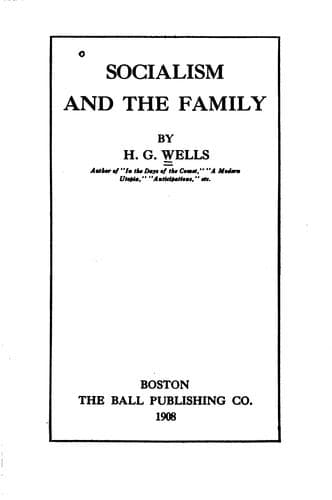
Socialism and the familyWells, H. G. (Herbert George)
General
Socialism and the family
Wells, H. G. (Herbert George)
Families; Middle class; Socialism
The second direction is towards reaction, an attempt to return to the
simple old conceptions of our past, to the patriarchal family, that is
to say, of the middle ages. This I take to be the conception of such a
Liberal as Mr. G. K. Chesterton, or such a Conservative as Lord Hugh
Cecil, and to be also as much idea as one can find underlying most
tirades against modern morals. The rights of the parent will be insisted
on and restored, and the parent means pretty distinctly the father.
Subject to the influence of a powerful and well-organized Church, a
rejuvenescent Church, he is to resume that control over wife and
children of which the modern State has partially deprived him. The
development of secular education is to be arrested, particular stress is
to be laid upon the wickedness of any intervention with natural
reproductive processes, the spread of knowledge in certain directions is
to be made criminal, and early marriages are to be encouraged.... I do
not by any means regard this as an impossible programme; I believe that
in many directions it is quite a practicable one; it is in harmony with
great masses of feeling in the country, and with many natural instincts.
It would not of course affect the educated wealthy and leisurely upper
class in the community, who would be able and intelligent enough to
impose their own private glosses upon its teaching, but it would
“moralize” the general population, and reduce them to a state of
prolific squalor. Its realization would be, I believe, almost inevitably
accompanied by a decline in sanitation, and a correlated rise in
birth-rate and death-rate, for life would be cheap, and drainpipes and
antiseptics dear, and it is quite conceivable that after some stresses,
a very nearly stable social equilibrium would be attained. After all it
is this simple sort of life, without drains and without education, with
child labour (in the open air for the most part until the eighteenth
century—though that is a detail) and a consequent straightforward desire
for remunerative children that has been the normal life of humanity for
many thousands of years. We might not succeed in getting back to a
landed peasantry, we might find large masses of the population would
hang up obstinately in industrial towns—towns that in their simple
naturalness of congestion might come to resemble the Chinese pattern
pretty closely; but I have no doubt we could move far in that direction
with very little difficulty indeed.
Public-domain text, read in full here on John Shaqi.
Reviews
Reviews
No reviews yet
Be the first to share your thoughts on this work.
Join the Discussion
Join the discussion
Sign in to leave a comment or review.
Sign InorCreate an account