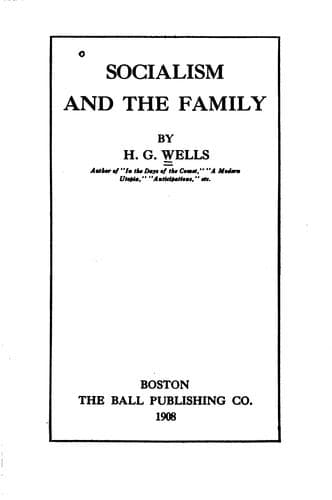
Socialism and the familyWells, H. G. (Herbert George)
General
Socialism and the family
Wells, H. G. (Herbert George)
Families; Middle class; Socialism
The third direction is towards the developing conceptions of Socialism.
And it must be confessed at once that these, as they emerge steadily and
methodically from mere generalities and confusions, do present
themselves as being in many aspects, novel and untried. They are as
untested, and in many respects as alarming, as steam traction or iron
shipping were in 1830. They display, clearly and unambiguously,
principles already timidly admitted in practice and sentiment to-day,
but as yet admitted only confusedly and amidst a cloud of
contradictions. Essentially the Socialist position is a denial of
property in human beings; not only must land and the means of production
be liberated from the multitude of little monarchs among whom they are
distributed, to the general injury and inconvenience, but women and
children, just as much as men and things, must cease to be owned.
Socialism indeed proposes to abolish altogether the patriarchal family
amidst whose disintegrating ruins we live, and to raise women to an
equal citizenship with men. It proposes to give a man no more property
in a woman than a woman has in a man. To stupid people who cannot see
the difference between a woman and a thing, the abolition of the private
ownership of women takes the form of having “wives in common,” and
suggests the Corroboree. It is obviously nothing of the sort. It is the
recognition in theory of what in many classes is already the fact,—the
practical equality of men and women in a civilized state. It is quite
compatible with a marriage contract of far greater stringency than that
recognized throughout Christendom to-day.
Now what sort of contract will the Socialist state require for marriage?
Here again there are perfectly clear and simple principles. Socialism
states definitely what almost everybody recognizes nowadays with greater
or less clearness, and that is the concern of the State for children.
The children people bring into the world can be no more their private
concern entirely, than the disease germs they disseminate or the noises
a man makes in a thin-floored flat. Socialism says boldly the State is
the Over-Parent, the Outer-Parent. People rear children for the State
and the future; if they do that well, they do the whole world a service,
and deserve payment just as much as if they built a bridge or raised a
crop of wheat; if they do it unpropitiously and ill, they have done the
world an injury. Socialism denies altogether the right of any one to
beget children carelessly and promiscuously, and for the prevention of
disease and evil births alike the Socialist is prepared for an
insistence upon intelligence and self-restraint quite beyond the current
practice. At present we deal with all that sort of thing as an
infringement of private proprietary rights; the Socialist holds it is
the world that is injured.
Public-domain text, read in full here on John Shaqi.
Reviews
Reviews
No reviews yet
Be the first to share your thoughts on this work.
Join the Discussion
Join the discussion
Sign in to leave a comment or review.
Sign InorCreate an account