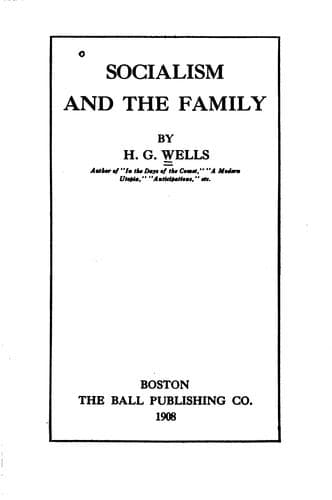
Socialism and the familyWells, H. G. (Herbert George)
General
Socialism and the family
Wells, H. G. (Herbert George)
Families; Middle class; Socialism
It follows that motherhood, which we still in a muddle-headed way seem
to regard as partly self-indulgence and partly a service paid to a man
by a woman, is regarded by the Socialists as a benefit to society, a
public duty done. It may be in many cases a duty full of pride and
happiness—that is beside the mark. The State will pay for children born
legitimately in the marriage it will sanction. A woman with healthy and
successful offspring will draw a wage for each one of them from the
State, so long as they go on well. It will be her wage. Under the State
she will control her child’s upbringing. How far her husband will share
in the power of direction is a matter of detail upon which opinion may
vary—and does vary widely among Socialists. I suppose for the most part
they incline to the conception of a joint control. So the monstrous
injustice of the present time which makes a mother dependent upon the
economic accidents of her man, which plunges the best of wives and the
most admirable of children into abject poverty if he happens to die,
which visits his sins of waste and carelessness upon them far more than
upon himself, will disappear. So too the still more monstrous absurdity
of women discharging their supreme social function, bearing and rearing
children in their spare time, as it were, while they “earn their living”
by contributing some half mechanical element to some trivial industrial
product, will disappear.
That is the gist of the Socialist attitude towards marriage; the
repudiation of private ownership of women and children, and the payment
of mothers. Partially but already very extensively, socialistic ideas
have spread through the whole body of our community; they are the saving
element in what would otherwise be a moral catastrophe now, and the
Socialist simply puts with precise definition the conclusions to which
all but foolish, ignorant, base or careless people are moving—albeit
some are moving thither with averted faces. Already we have the large,
still incomplete edifice of free education, and a great mass of
legislation against child labour; we have free baths, free playgrounds,
free libraries,—more and more people are coming to admit the social
necessity of saving our children from the private enterprise of the
milkman who does not sterilize his cans, from the private enterprise of
the schoolmaster who cannot teach, from the private enterprise of the
employer who takes them on at small wages at thirteen or fourteen to
turn them back on our hands as ignorant hooligans and social wastrels at
eighteen or twenty.... But the straightforward payment to the mother
still remains to be brought within the sphere of practical application.
To that we shall come.
Butler & Tanner, The Selwood Printing Works, Frome, and London
------------------------------------------------------------------------
_A. C. FIFIELD’S NEW LIST._
THE BISHOPS AS LEGISLATORS:
Public-domain text, read in full here on John Shaqi.
Reviews
Reviews
No reviews yet
Be the first to share your thoughts on this work.
Join the Discussion
Join the discussion
Sign in to leave a comment or review.
Sign InorCreate an account