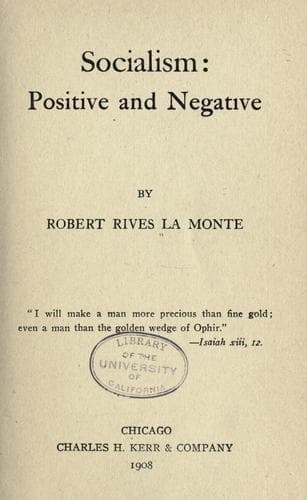
Socialism: Positive and NegativeLa Monte, Robert Rives
Philosophy
Socialism: Positive and Negative
La Monte, Robert Rives
Socialism
George Bernard Shaw, in the preface to "Plays, Pleasant and Unpleasant,"
says: "I have no respect for popular morality." A few weeks since, a
workingman, who had been listening to a stereotyped sentimental harangue
emitted by one of our amiable Utopian comrades, showed me the palms of
his hands, which were thickly studded with callouses, and asked me,
"What the hell has a fellow with a pair of mits like those to do with
morality? What I want is the goods." Shaw meant just what he wrote; yet
the critics will continue to treat his utterance as one of Bernard
Shaw's "delightfully witty paradoxes." My friend meant just what he
said; yet Salvation Armyists and other good Christians will continue to
preach to him and his kind a religion and a morality which have become
meaningless to them.
Organized government, with its power to make laws and levy taxes--in
other words, the State--only came into existence with the division of
society into classes. The State is, in its very essence, a class
instrument--an agency in the hands of the ruling class to keep the
masses in subjection. Hence the name, "State," cannot fitly be applied
to the social organization of a society in which there are no classes,
whether that society be the primitive communist group of savagery or the
co-operative commonwealth of the future.
The word "capital," cannot be applied to the machinery and means of
production in any and every society. They only become capital when they
are used as means to exploit (rob) a subject class of workers, and when
they shall cease to be so used they will cease to be capital. The word
"wages," necessarily implies the extraction of surplus-value (profits)
from the workers by a parasitic class; hence, that share of the social
product which the workers of the future will devote to individual
consumption cannot be correctly spoken of as "wages."
In the same way, morality is, in its very essence, a class
institution--a set of rules of conduct enforced or inculcated for the
benefit of a class. Hence, to speak of the morality of the future, when
one refers to the classless society to which Socialists look forward, is
the height or the depth of absurdity. In the free fellowship of the
future there will be no morality. This is not saying that there will be
no criteria by which conduct will be praised or deplored; it is simply
saying that with the abolition of classes, morality, like the State,
capital and wages, being a product of class-divisions, will cease to
exist.
Public-domain text, read in full here on John Shaqi.
Reviews
Reviews
No reviews yet
Be the first to share your thoughts on this work.
Join the Discussion
Join the discussion
Sign in to leave a comment or review.
Sign InorCreate an account