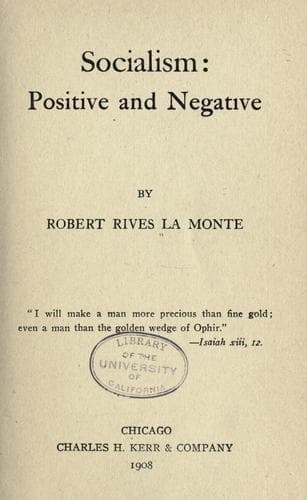
Socialism: Positive and NegativeLa Monte, Robert Rives
Philosophy
Socialism: Positive and Negative
La Monte, Robert Rives
Socialism
While the revolutionary proletariat have no respect for current
morality, it is none the less true that they have in process of growth a
morality of their own--a morality that has already emerged from the
embryonic stage. The proletariat are to be the active agents in bringing
to pass the social revolution which is to put a period to Capitalism and
usher in the new order. During this transition period and until the
change is fully accomplished, they will be a distinct class with special
class interests of their own. As fast as they become class-conscious
they will recognize and praise as moral all conduct that tends to hasten
the social revolution--the triumph of their class, and they will condemn
as unhesitatingly as immoral all conduct that tends to prolong the
dominance of the capitalist class. Already we can note manifestations of
this new proletarian morality in that sense of class solidarity
exhibited by the workers in the many acts of kindness and assistance of
the employed to the unemployed, and more especially in the detestation
in which the scab is held.
The revolutionary workingman, be he avowed Socialist or not, who
repudiates the current or capitalist morality, does not abandon himself
to unbridled license, but is straightway bound by the obligations of the
adolescent proletarian morality which is enforced with ever greater
vigor by the public opinion of his class as his class grows in
class-consciousness.
Does the new morality condemn what the old branded as "crimes against
property?" It must be confessed that the revolutionary worker has
absolutely no respect for natural rights--including the right of
property--as such. Hence, as the act of an individual in appropriating
the goods of another is not likely either to help or to injure his
class, he neither approves or condemns it on moral grounds; but knowing,
as he does, that his class enemies, the capitalists, own not only "the
goods," but also the courts and the police, he condemns theft by a
workingman as suicidal folly.
The Marxist absolutely denies the freedom of the will.[4] Every human
action is inevitable. "Nothing happens by chance." Every thing is
because it cannot but be. How then can we consistently praise or blame
any conduct? If one cares to make hair-splitting distinctions, it may be
replied that we cannot, but none the less we can rejoice at some actions
and deplore others. And the love of praise, with its obverse, the fear
of blame, has ever been one of the strongest motives to human conduct.
It is not necessarily the applause of the thoughtless multitude that one
seeks; but in writing this paper, which I know will be misunderstood or
condemned by the majority of those who read it, undoubtedly one of my
motives is to win the approbation of the discerning few for whose good
opinion I deeply care.
Public-domain text, read in full here on John Shaqi.
Reviews
Reviews
No reviews yet
Be the first to share your thoughts on this work.
Join the Discussion
Join the discussion
Sign in to leave a comment or review.
Sign InorCreate an account